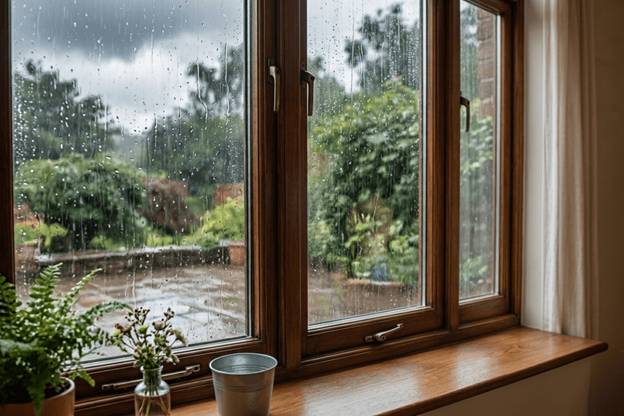
During monsoons, water leakage through windows is caused by failed weather seals, improper drainage, or poor installation. It may also happen because the entire window system fails to withstand wind-driven rain. Even if you have a roof overhanging your windows, the rain will hit your glass directly because of strong winds. This leads to water leaking inside, dampening walls, and damaging wooden furniture.
So, high-performance waterproof uPVC window profiles address these risks through:
- engineered sealing systems
- precision drainage channels
- reinforced profiles
- secure locking hardware
How Can I Stop Water Leakage Through My Windows This Monsoon?
Window leakage can be stopped by using uPVC windows with EPDM compression gaskets, multi-point locking systems, precision drainage channels, and professionally installed frames.
For a window system to perform better during the monsoon, these features must work together.
The leakage is not always caused by a single component. It results from a combination of issues, such as:
- sealing failure
- insufficient locking failure
- blocked drainage
- frame movement due to wind pressure
You may apply an exterior silicone temporarily to reduce leakage, but it will not solve the poor window engineering. A properly engineered leak-resistant window system performs three critical functions simultaneously:
- Seals the gap between the frame and sash
- Applies even pressure around the window
- Channels rainwater safely outside
Any failure in the functioning of these components results in water penetration.
EPDM Gaskets
EPDM (Ethylene Propylene Diene Monomer) gaskets offer better weather protection than conventional rubber seals because they are made from durable synthetic rubber.
Even under prolonged exposure to UV rays, EPDM gaskets retain their elasticity. They can also handle humidity, ozone, and temperature fluctuations.
By keeping the sash and frame in continuous contact, the gasket minimises air penetration and stops wind-driven rain from bypassing the weather seal.
Another advantage of EPDM is its low compression set. This means gaskets maintain sealing pressure even after several years of usage, preventing leakage.
EPDM Gaskets vs. Traditional Seals
Traditional rubber gaskets lose elasticity in the long run because heat, sunlight, and moisture accelerate oxidation, causing the material to harden, shrink, and crack. Even small gaps created by seal deterioration allow water to penetrate.
| Feature |
EPDM Gaskets |
Traditional Rubber Seals |
| UV Resistance |
Stays flexible in sunlight. |
Hardens and cracks over time. |
| Sealing Performance |
Maintains a tight seal for years. |
Loses its sealing ability faster. |
| Durability |
Long-lasting. |
Wears out sooner. |
| Weather Resistance |
Resists heat, rain, humidity, and ozone. |
More likely to deteriorate in harsh weather. |
| Water Protection |
Helps prevent water leakage. |
Can develop gaps that allow water inside. |
Why Multi-Point Locking Systems Prevent Frame Rattling in High Winds
A multi-point locking system secures the window sash at multiple locations around the frame. This improves gasket compression, evenly distributes closing pressure, and prevents water ingress.
Strong winds cause minor sash vibration or deflection during heavy rains. The weather seal may be compromised by even a small movement, allowing wind-driven rain to enter the frame.
Multi-point locking systems reduce this issue by exerting uniform compression along the window’s perimeter. The sash is securely held against the EPDM gasket by the locking points’ simultaneous engagement, which ensures a constant seal. In addition to enhancing weather resistance, multi-point locking systems also
- Increases airtightness
- Improves acoustic insulation
- Limits air movement
- Adds multi-point locks
- Prevents frame warping
Multi-point locking mechanisms increase a uPVC window’s overall water tightness when paired with sturdy EPDM gaskets.
Why Installation Quality Matters as Much as Window Design
Even the most advanced window system can fail if it is poorly installed. Improper alignment, uneven anchoring, installation gaps, or poor perimeter sealing lead to water infiltration.
So a trained professional is needed to ensure that the frame remains even, level, and securely fixed to the wall opening. This allows different components of a window to function as designed.
Before installation is considered complete, installers should verify:
- Uniform frame alignment
- Correct anchoring and fixing points
- Continuous perimeter sealing
- Unobstructed drainage outlets
- Smooth locking operation
- Even gasket compression around the sash
Other Key Elements of a Leak-Proof Window
Smooth Operation Protects Window Components
A properly installed uPVC window must open, close, and lock smoothly. Proper alignment keeps the hinges, handles, rollers, and locking system working correctly. Poor alignment causes extra friction, and it can damage the hardware and other parts, including gaskets.
Long-Term Stability in Changing Weather
During heavy rain and wind, a leak-proof window must hold its shape. Secure anchoring and reinforced uPVC profiles keep the frame in shape, avoiding bending or twisting. This ensures the EPDM gasket is compressed uniformly to keep water out.
What Are the Best Leak-Proof Windows for Heavy Rain in India?
There are different types of leak-proof uPVC windows available in India. So, the choice depends on your needs.
- Sliding Windows
- Casement Windows
- Arch Windows
- Combination Windows
- Tilt and Turn Windows
- Villa Windows
The Role of Precision Drainage Systems in uPVC Sliding Windows
Drainage systems prevent the accumulation of water, channeling it through specially designed drainage outlets. This allows windows to perform effectively even during prolonged rainfall.
A high-performance drainage system typically includes:
- External water collection chambers
- Drainage channels (sloped)
- Pressure equalisation chambers
- Weep holes
Wind pushes rain into your windows. So, clearing the tiny drain holes at the bottom of the frame helps water flow outside. Otherwise, water will leak into your home.
Casement vs Sliding Windows: Which Design Offers Better Monsoon Sealing?
Though both windows are suitable for the monsoon, the uPVC casement window has a slight advantage because of compression sealing.
To close a casement window, the sash must be pressed tightly against the EPDM gasket. All four sides of the frame are uniformly compressed by multi-point locking hardware, creating a continuous weather barrier that prevents both air and water infiltration.
The compression-seal design provides:
- Increased water tightness
- Increased resistance to wind
- Reduced penetration of air
- Better insulation against heat
- Improved sound quality
On the other hand, sliding windows depend on drainage systems and weather seals, but they can also deliver excellent rain protection when engineered correctly.
Sliding windows use a different sealing principle. The sash moves horizontally along the tracks, making compression sealing impractical. Siding window systems depend on precision manufacturing, interlocking sash profiles, weather brushes, EPDM seals, and engineered drainage chambers to control water movement.
However, modern premium uPVC sliding windows perform well during Indian monsoons because the built-in drainage systems remove rainwater before it reaches the indoors. For homes where space is a constraint, sliding windows provide an excellent balance between performance and practicality.
Why Multi-Chamber uPVC Profiles Improve Weather Resistance
Multi-chamber uPVC profiles improve weather resistance by using trapped pockets of air in the profiles. These pockets or chambers prevent water penetration and provide structural rigidity against extreme climates.
A strong frame is necessary for maintaining gasket compression. If the frame bends due to wind pressure, the weather seal may be separated from the sash. This creates a small gap between the gasket and frame, allowing rainwater to pass.
Multi-chamber profiles help minimise this movement by:
- Increasing profile stiffness
- Improving dimensional stability
- Reducing thermal expansion
- Supporting reinforcement where required
- Improving energy efficiency
The number of chambers does not solely determine the quality of a window. In fact, the number of chambers above a certain number will not have any impact on window performance,
about engineering. Profile geometry, wall thickness, reinforcement design, and manufacturing precision have a direct impact on the window’s performance.
Why Welded Corners Matter in Leak-Proof Windows
Raw extruded profiles are cut according to the required size to make a window frame. The cut profiles are fusion-welded at the corners to create a continuous joint between them, eliminating gaps that could become leakage points.
Welded corners improve structural integrity and help maintain long-term weather resistance.
Due to frequent opening, closing, and thermal movement, corners are always under stress. The sealing performance surrounding the frame may also become loose because of poorly constructed joints.
Fusion welding provides several advantages:
- Continuous weatherproof joints
- Higher structural strength
- Reduced risk of corner separation
- Improved dimensional stability
- Better long-term durability
Monsoon Maintenance Checklist
Before the arrival of every monsoon, check your entire window system to avoid issues later.
- Clean drainage channels and weep holes
- Remove dust from the sliding tracks
- Inspect EPDM gaskets for cuts or hardening
- Check handles and locking points for smooth operation
- Ensure drainage outlets are unobstructed
- Replace damaged sealants if necessary
- Schedule professional servicing if the window no longer closes tightly
Conclusion
The performance of a good window depends not only on the frame but on how well each part of a window works. EPDM gaskets, multi-point locking systems, multi-chambered profile, drainage outlets, reinforced frames – all needed to prevent water from passing inside and withstand heavy winds. Manufacturers like Ökotech build their uPVC windows with these exact features to handle Indian monsoons.
Here’s what makes Okotech a preferred choice among fabricators, interior designers, and architects.
- German Extrusion Technology:uPVC profiles are extruded using advanced German machinery at state-of-the-art manufacturing facilities for precision in manufacturing.
- Multi-Chambered Design:Multiple internal chambers provide extra structural support, making them capable of handling rain and high-speed winds.
- Optimized Chemical Composition:The uPVC blend consists of premium resins, Titanium Dioxide (TiO₂) for UV resistance, and low levels of Calcium Carbonate (CaCO₃) to prevent fading and brittleness.
- Lead-Free Formulation:Complies with European safety standards to provide safe, eco-friendly, and RoHS-compliant profiles.
Frequently Asked Questions
Why does water enter through closed windows?
Water enters the closed window because of damaged seals, blocked drainage channels, poorly installed frames, or inadequate locking pressure.
Do all uPVC windows offer the same level of waterproofing?
No, the waterproofing levels depend on various factors like profile design, gasket quality, drainage engineering, hardware, reinforcement, manufacturing precision, and installation quality.
Can blocked weep holes cause window leakage?
Yes, blocked weep hole outlets don’t allow rainwater to escape the frame, causing water accumulation and overflow into the rooms.
Can old uPVC windows start leaking?
Yes, old uPVC windows can leak if their EPDM gaskets lose elasticity. So, regular maintenance and timely replacement of worn components are necessary to maintain weather resistance.
How often should window gaskets be replaced?
High-quality EPDM gaskets last 15–20 years under normal conditions. But they must be insp ected every year before the start of the monsoon. Look for signs of hardening, cracks, shrinkage, or loss of flexibility. If they are worn out or if water or air starts entering the window, replace them immediately.
What is the difference between waterproof and weatherproof windows?
No window is completely waterproof because windows are made of several parts that must allow opening, closing, and drainage. High-quality uPVC windows are weatherproof, i.e, they are engineered to resist wind-driven rain, air leakage, and moisture under tested conditions.