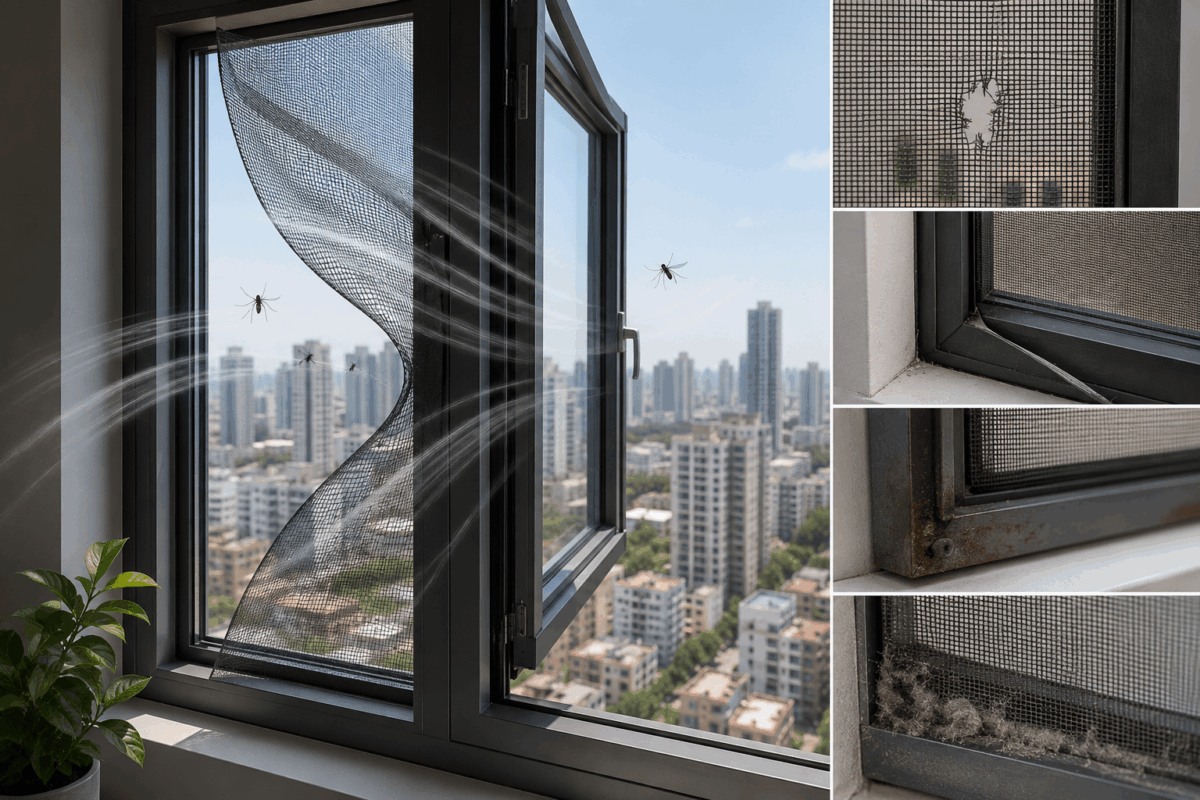
What Causes the Rattling
A screen held in by friction or clips vibrates under wind pressure. Each gust stretches the mesh slightly. Over weeks, the gap between mesh and frame widens, the seal breaks, and the rattling gets worse. Re-fitting the same screen does not fix this. A track-locked system, which captures the mesh edge mechanically at every point, distributes wind pressure evenly across the full perimeter instead of hammering the weakest corner.
Screens That Pop Out Are a Safety Risk
Standard screens resist force from inside but they are not sustained to handle wind pressure from outside. The failure is sudden without indications of bending or warning. At 20 floors, that is a falling object. An integrated mesh track, where the mesh sits inside the frame extrusion rather than clipped onto it, locks the panel as a single unit. There is no weak point for pressure to exploit.
Why Dust Gets In Despite a Closed Screen
At altitude, wind does not push through the mesh, it goes around it. Any edge gap is a direct path for PM2.5, pollen, and monsoon debris that bypasses the mesh entirely. Mesh density does not matter if air is not passing through it. A mid-density mesh in a precision-fit integrated track blocks more than a fine mesh in a loose frame.
The Right Screen for High-Rise Apartments
Fixed Mesh for Ventilators and Secondary Openings
Ventilators and kitchen openings rarely need to move. A fixed mesh system has no mechanical parts to fail. The mesh is tensioned at manufacture and stays that way. Wind load goes straight into the frame and wall anchor. For a ventilator 22 floors up, a roller system only adds cost and failure modes a fixed panel does not have.
Track-Locked Rollers for Daily-Use Windows
On a standard roller mosquito net, the mesh floats in wide side channels. Wind pushes it away from the channels, gaps open along the sides, and the cassette mechanism takes the stress. On a track-locked roller, precision-extruded channels grip the mesh edge along the full travel height. The panel stays flat at every position — fully open, half-open, or anywhere between. For high-rise window screen installation across India, this is what separates a screen that lasts from one replaced every two monsoons.
Also Read: uPVC Mesh: Practical Upgrade for Airflow, Protection and Daily Comfort
Mesh Density Above the 20th Floor
Finer mesh means more surface area and more wind pressure on the frame. For most Indian high-rise apartments — mosquitoes, urban dust, monsoon debris — an 18×16 density in fibreglass covers both filtration and structural load.
Why You Need to Choose Okotech?
3 million+ installations
Okotech has an experience of installing over 3 million installations.
100% lead-free profiles
Lead stabilizers are cheaper, so they are used mostly in lower-cost uPVC products. They degrade faster under UV and leach into indoor air. Okotech’s lead-free formulation helps occupant’s health and product lifespan.
End-to-end process
Same team for site survey, fabrication, and installation. A screen measured by one contractor, made by another, and installed by a third accumulates errors at every handoff. Okotech removes those handoffs entirely.
Quality Check
Every Okotech passes multiple tests before leaving the facility. Some of these tests include wind resistance, pull strength, impact resistance.
Integrated vs Add-On Mesh Tracks
Standard frames use add-on tracks that loosen under strong winds. Okotech frames have an integrated track built directly into the metal shape. Above 10 floors, this is considered a baseline.
Galvanized Steel Core for Large Spans
Unreinforced large windows bend and break in high winds. Okotech’s built-in steel core prevents this damage completely.
UV-Stable Profiles
Unprotected windows degrade rapidly under intense Indian sunlight. Okotech’s advanced formulation prevents this damage for over a decade. This results in long lasting profiles that do not fade or turn yellow.
Takeaway
Standard mosquito mesh is not a high-rise product. The wind loads are different, the failure modes are different, the consequences are different. Screens that hold at altitude are built as full systems — integrated track-locked profiles, steel-core reinforcement, UV-stable lead-free materials, tested as assemblies. Okotech has built over 3 million of them across India’s residential towers.
FAQs
Why do normal mosquito nets fail in high-rise flats?
High floors get very strong winds, especially during monsoons. This heavy wind pressure simply tears normal nets or pulls them out of their frames.
Up to which floor can I use regular mosquito nets?
Regular nets work fine up to the 4th floor. Above the 8th floor, standard or cheap nets will easily break or fly away.
Can I use folding (pleated) or roller nets?
Normal folding nets will rattle and pop out of the side tracks. If you want roller nets, buy the Zip-System kind which locks the net tightly into the borders.
Do high-rise nets block the outside view
No, Premium Nets use very thin wires. They block mosquitoes and dust while keeping your view clear.