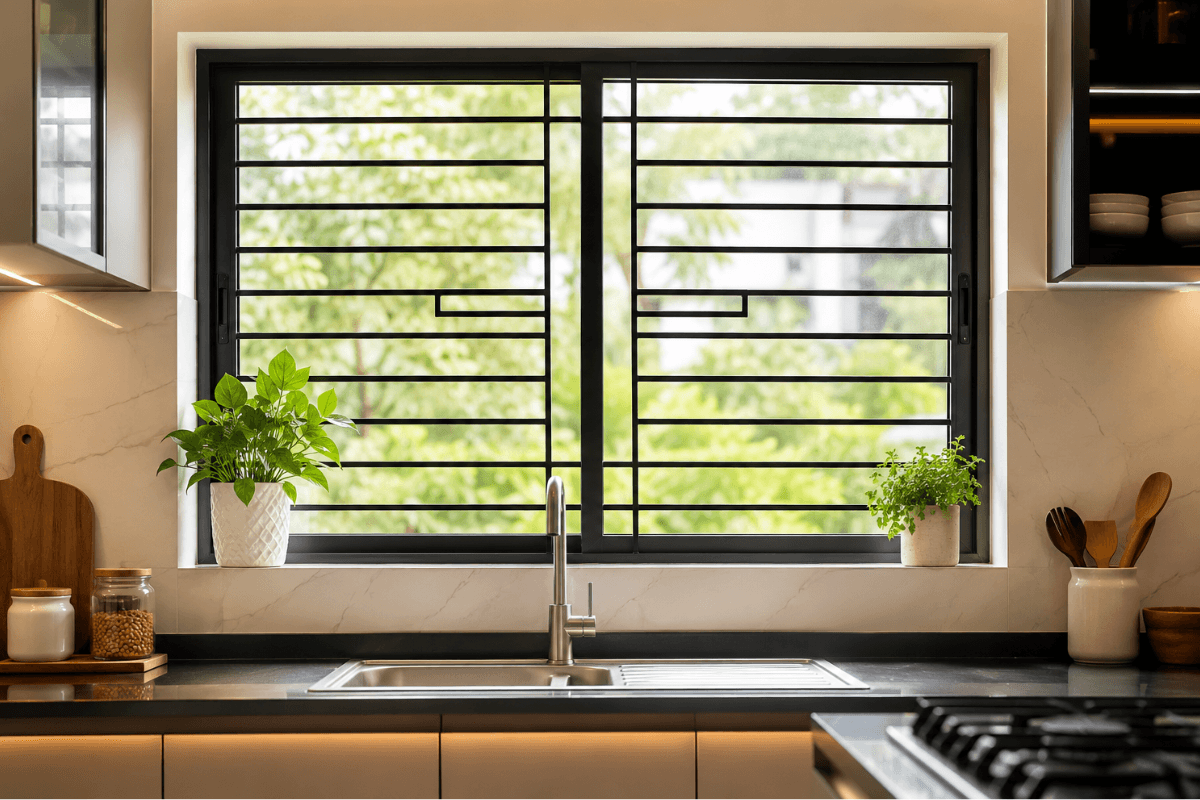
To choose a kitchen window grill, you need to consider four things: ventilation, safety, ease of cleaning, and how well the grill fits with the rest of the window.
Many focus only on looks, but it shouldn’t be the deciding factor. Kitchen windows deal with steam, cooking fumes, grease, and daily cleaning. So the grill must handle that stuff without getting in the way of everyday use.
This guide covers how to pick the right window grill for a kitchen, how to plan a grill that doubles as gardening space, and how to integrate frame-and-mesh systems for everyday use, all without sacrificing airflow or day-to-day practicality.
What Makes a Kitchen Window Grill Modern in 2026?
A modern kitchen window grill does more than provide security. It is designed to balance ventilation, safety, durability, ease of maintenance, and aesthetics. Unlike traditional decorative grills, modern designs work as part of the complete window system, ensuring uninterrupted airflow, insect protection, and convenient day-to-day use.
It Should Preserve the Effective Ventilation Opening
Airflow efficiency depends on the clear, unobstructed space remaining after grille installation, not the nominal window frame dimensions. Dense patterns, excessive bars, and decorative flourishes are the critical airflow blockages. Even when the window size remains the same, excessive grill members reduce the effective ventilation opening by limiting the free passage of air. Simple, open grill layouts allow better natural ventilation while maintaining security.
When reviewing a kitchen grill design, check that:
- The operable sash still opens fully
- Grill bars don’t sit across the main airflow path
- Window handles stay within easy reach
- There’s room to fit an insect mesh without conflict
- Glass can still be reached for cleaning.
Reviewing the grill and the window together at the planning stage itself, instead of approving them as separate line items, helps avoid installation headaches later.
Simpler Patterns Mean Less Grease, Less Cleaning
Kitchen air carries oil droplets which settle on nearby surfaces over time, including grills. Ornate scrollwork, tight intersections, and deep decorative recesses give grease more places to collect.
For a grill that’s easier to keep clean, look for:
- Straight horizontal and vertical members instead of curved or layered patterns
- Smooth, welded joints with no fussy detailing
- Enough hand clearance to wipe down properly
- Clear access around the frame perimeter
You don’t have to compromise on a contemporary look to get this; clean lines are also a current kitchen design trend in 2026.
This is one reason why straight-line grill designs are increasingly preferred in modern kitchens—they minimise grease build-up while making routine cleaning faster and more effective.
Also Read: How to stop window leakage in monsoon
It Should Work With the Window, Not Around It
A kitchen window is more than just a piece of glass and a frame. It’s the profile, the sash, the glazing, the hardware, the insect mesh, and the grill. All these elements must work together to ensure the window performs efficiently and delivers the intended functionality.
How a Box Window Grill Adds Everyday Utility
A box grill projects outward from the outer wall. This creates a usable space without occupying the kitchen’s internal areas. If it is planned during the design or installation stage, it not only provides security but also adds function.
Creates Room for Small Daily Tasks
Unlike a flat grill, which primarily provides security, a box grill offers a small ledge that can be used for:
- Growing herbs
- Holding a lightweight utility basket
- Drying kitchen cloths
- Setting aside washed vegetables for a bit.
- A small planter or two
This box grill comes in handy in compact apartments, homes, or places where there are no dedicated utility spaces.
Planning It Early Keeps the Facade Consistent
When a box grill is installed after the building is complete, it may not align with the building facade. Planning it during the design stage helps ensure consistent fabrication, better alignment, and fewer site modifications.
- A more uniform building facade.
- Consistent fabrication across units.
- Fewer site modifications after handover.
- Better alignment with the window openings themselves.
Structural Checks Matter Before Approval
A projected grill adds load at its fixing points, so it’s worth reviewing a few things before signing off:
| Design Check |
Why It Matters |
| Grill Depth |
Does not block the window from opening. |
| Wall Fixings |
Strong enough to hold the heavy grill. |
| Gap Size |
Leaves enough room to clean the glass. |
| Extra Weight |
Safe if you put heavy plant pots on it. |
| Window Movement |
The window glass or mesh opens fully. |
A box grill sized for light utility use can run into trouble if heavy planters get added later without checking the load it was actually designed for.
In apartment buildings, it’s also important to comply with the builder’s specifications or local regulations regarding grill projections and structural fixing methods.
Designing a Kitchen Window Grill With Gardening Space
A grill built with gardening in mind should hold lightweight planters without cutting into ventilation, daylight, or how the window opens. The goal is a small herb-growing spot that doesn’t come at the cost of the window’s main job.
Keep the Airflow Path Clear of Planters
Planters shouldn’t sit in the main ventilation zone. A few things help here:
- Position planters below the main airflow area, not across it.
- Leave clearance around the operable sash.
- Avoid oversized pots that end up shading the opening.
- Make sure there’s drainage so water doesn’t collect near the window frame.
Keeping that airflow path open matters more in a kitchen than almost anywhere else in the house — it’s what lets cooking heat and moisture actually escape.
Pick Plants That Suit a Small Grill Space
Compact herbs with shallow root systems work best here. Good options include mint, coriander, basil, curry leaves and green chillies — all easy to maintain, frequently harvested, and well suited to a small planter box on a kitchen grill.
Choose lightweight planters with proper drainage to prevent water accumulation around the window frame while avoiding unnecessary structural load on the grill.
Why Frame-and-Mesh Hybrid Systems Are Gaining Ground
A good kitchen grill needs to do more than keep intruders out — it also needs to let the window stay open without inviting insects in. A frame-and-mesh hybrid brings together an operable window, a security grill, and a removable insect mesh, letting each part do its job without getting in the way of the others.
It Keeps Ventilation Usable Through the Day
A lot of homeowners just don’t open their kitchen windows because of mosquitoes and flies — and then cooking heat, moisture and odours have nowhere to go.
A hybrid system solves this reasonably simply: the mesh acts as the insect barrier, so the window itself can stay open.
That offers you:
- Ventilation that doesn’t have to be sacrificed for pest control
- Fewer mosquitoes getting in
- A more comfortable kitchen while cooking
- Better daylight without keeping the window shut
- A mesh that comes off easily for cleaning
For fabricators, building the mesh in during fabrication tends to give a cleaner result than fitting an aftermarket mesh system later.
This integrated approach also reduces the need for separate aftermarket mesh installations, resulting in a cleaner appearance and better long-term compatibility with the window system.
A Removable Mesh Is Much Easier to Live With
Kitchen insect screens pick up grease, fumes and dust over time — and a mesh that’s permanently fixed in place often means accessing the whole window from outside just to clean it.
A removable mesh, by contrast, allows:
- Taking the mesh off on its own.
- Washing it properly.
- Cleaning the glass behind it without extra hassle.
- Putting it back without disturbing the grill or hardware.
That’s a meaningful difference for homeowners day to day, and it usually means fewer service calls for fabricators down the line.
Also Read: How to choose the right uPVC profile for high-rise buildings
Matching the Grill Design to Different Kitchen Layouts
No one grill design works for every kitchen. What fits depends on the layout, which way the window faces, how much wall space is available, and how the kitchen actually gets used.
Parallel Kitchens Need Maximum Ventilation From Limited Wall Space
With usually just one external wall to work with, parallel kitchens do better with:
- An open grill geometry rather than a dense one.
- Straight members instead of decorative patterns.
- Full sash opening.
- Easy mesh access.
- Handles that stay easy to reach.
Decorative patterns that cut into the effective ventilation opening are worth avoiding here specifically because there’s so little wall space to begin with.
L-Shaped Kitchens Need Better Daylight Distribution
When the window sits above the sink, it needs to spread daylight to both counters, not just the one directly beneath it. That calls for even bar spacing, minimal visual obstruction, easy cleaning access, and compatibility with sliding or casement windows.
Compact Apartments Do Well With a Box Grill
Where utility space is tight, a box grill can carve out a bit of external space for herb planters, a lightweight basket, cleaning supplies, or drying cloths — all without touching the internal floor area. Planning this at the design stage avoids the patchwork look that comes from adding it after handover, unit by unit.
The ideal kitchen window grill design depends on the kitchen layout, ventilation requirements, window type, and intended everyday use rather than on following a single design style. Selecting the grill alongside the window system helps improve functionality, installation quality, and long-term performance.
How to Choose the Right Grill for Your Kitchen
Choosing the right kitchen window grill means weighing ventilation, maintenance, how the window operates, and how it’ll hold up over time — not picking based on looks alone.
Specification Checklist
Before finalising a design, confirm the grill:
- Keeps the ventilation path clear.
- Allows the window to open fully.
- Works with a removable insect mesh.
- Leaves room for easy cleaning.
- Doesn’t get in the way of the hardware.
- Can be maintained down the line without hassle.
- Fits the building’s facade.
- Actually meets the kitchen’s functional needs
- Uses corrosion-resistant materials or protective finishes suitable for the local environment.
Common Mistakes Worth Avoiding
- Picking decorative patterns that quietly cut into airflow.
- Fitting insect mesh that’s a pain to clean.
- Blocking drainage paths near the window.
- Placing planters where they interrupt ventilation.
- Installing grills without checking which way the window opens.
- Adding aftermarket grills that clash with the hardware.
- Selecting a grill design without considering future maintenance and cleaning access.
Catching these at the design stage is far easier than fixing them after installation.
Where uPVC Window Systems Fit In
While the grill contributes to safety and functionality, its performance ultimately depends on how well it integrates with the complete window system.
Ökotech’s uPVC window profiles are engineered with multi-chambered, steel-reinforced construction and multi-point locking hardware and are built to accommodate mesh and grill integration as part of the window rather than as an afterthought. uPVC as a material doesn’t rust, warp, or need repainting, which matters in a kitchen where the window is exposed to steam and grease daily. Ökotech’s sliding, casement and villa window ranges support grill and mesh customisation across several track configurations, so the grill can be planned in alongside the window rather than retrofitted later.
For architects and fabricators, specifying the window, hardware, mesh, and grill together at the design stage tends to produce a more coordinated result than treating them as separate purchases.
Key Takeaways
- A modern kitchen window grill should prioritise ventilation, maintenance and window operation over decorative complexity.
- A box window grill design creates useful external space without adding to the kitchen’s internal footprint.
- A grill built with gardening space in mind should preserve the main ventilation path and stay easy to maintain.
- Frame-and-mesh hybrid systems improve ventilation while cutting down on insect entry and simplifying cleaning.
- Planning the grill alongside the full window system, rather than as a separate accessory, gives better results over the long run.
Frequently Asked Questions
Which kitchen window grill design is easiest to maintain?
Straight-line patterns with smooth, welded joints are generally easier to clean — they simply have fewer surfaces for grease to collect on compared to ornamental designs.
Is a box window grill suitable for apartments?
Yes. It adds a bit of external utility space — for herb planters or lightweight items — without taking up any internal floor area.
Can a kitchen window grill with gardening space affect ventilation?
It can, if planters end up blocking the main airflow path. Keeping them below the ventilation zone, with enough clearance around the operable window, avoids this.
What is a frame-and-mesh hybrid system?
It’s a setup where a removable insect mesh is built into the window assembly alongside the grill, so the window can stay open for airflow while still keeping mosquitoes and insects out.
Should the grill be planned after the window is already installed?
Ideally not. Coordinating the grill, window profile, hardware, and mesh at the design stage tends to produce better installation quality and fewer issues down the line than adding the grill afterward.
Which material is best for a kitchen window grill?
Stainless steel and well-coated steel grills are popular choices because they offer strength and durability, while the right choice also depends on the local environment, maintenance requirements, and compatibility with the window system.