Lack of proper airflow is one of the main issues many homes and buildings face these days. Your staircases, parking areas, and utility spaces feel closed and stuffy. This is where uPVC louvers come in to address these issues.
In this write-up, we will see what uPVC louvers are, their types, designs, benefits, and the installation process.
What are uPVC Louvers?
uPVC louvers are architectural panels made of unplasticized polyvinyl chloride. Louvers are angled slant blades or slats fixed inside a frame. They allow air to pass through, block direct view, and reduce sunlight.
uPVC Louvers for Elevation
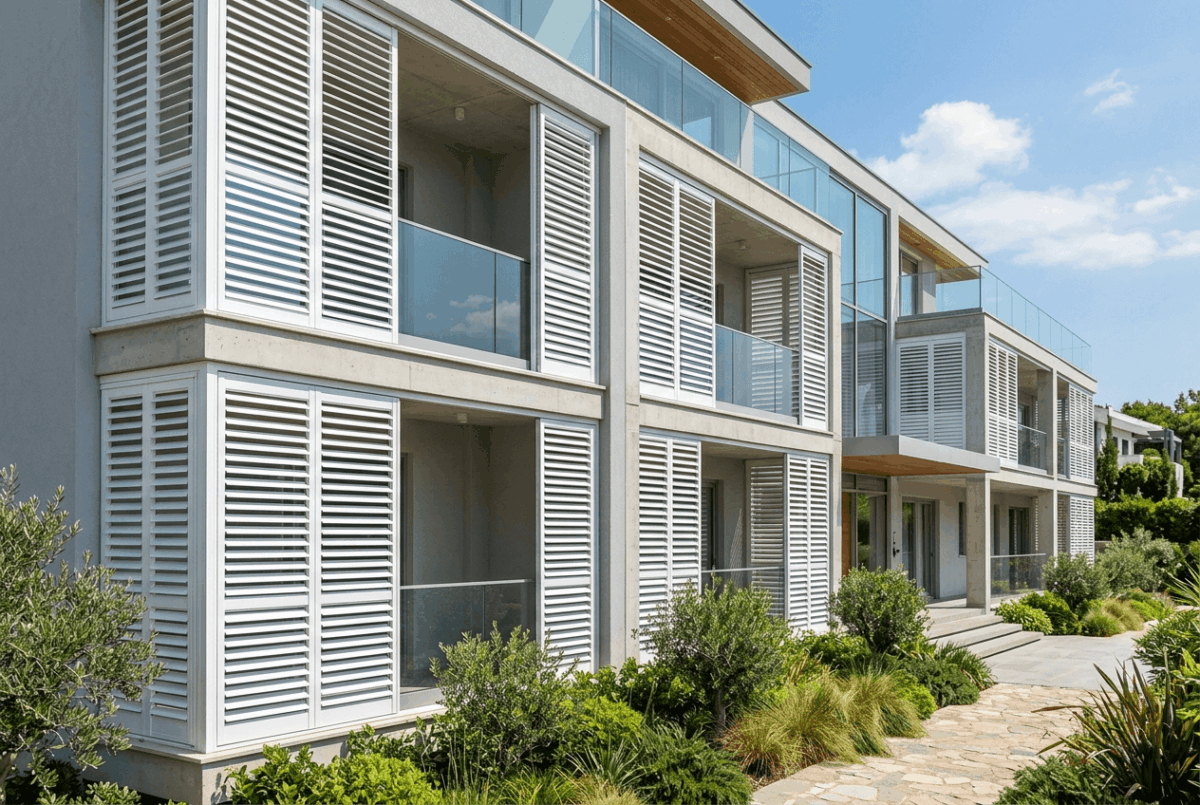
Interestingly, these days, louvers are also used in building elevations. They are used as outer walls, facade sections, or visible parts of the building.
Louvers add depth and enhance the curb appeal of the building. They can be used in areas where full openings are not possible, but ventilation is required.
Louvers are used on walls because they serve different purposes like providing better air flow, heat control, and privacy.
Types of uPVC Louvers
They are available in various types based on the usage requirement.
Fixed Louvers
In this type, the blades are fixed at a certain angle and do not move. These louvers allow constant airflow and require no maintenance. Used mostly in elevations, staircase walls, and parking areas.
Adjustable Louvers
Unlike fixed ones, in adjustable louvers, the blades can be tilted. It flexibility gives you control over the flow of air and light.
Glass Louvers
In glass louvers, slats or blades are made of glass, but the frame can be uPVC. Used in places where both light and air flow are needed. Mostly seen in bathrooms or ventilators.
Combination Louvers
This type of louvers uses a mix of materials or features.
For example, uPVC louvers with mesh (to block insects) or uPVC with glass combination. Used in places where multiple needs must be fulfilled.
uPVC Louvers Design
People are looking for more variations these days. So, let’s look at some of the uPVC louvers design options:
Orientation (Horizontal vs Vertical)
These can be placed either horizontally or vertically, depending on the design requirement. Horizontal louvers provide a cleaner look, while vertical louvers are used when a modern or different facade style is required.
Panel Design
In this design, the entire section of the wall is covered with louvers. This gives a uniform and clean look. Widely used in staircases or facade areas where ventilation is also needed.
Highlight Design
This design type includes the usage of louvers only in one part of the elevation, creating a focal point.
Mixed Material Design
Louvers can also be combined with other materials like glass, mesh, or cladding. This combination design is used when you need a bot function and design together.
Colour and Finish Options
Loyvers are available in a wide range of colours and finishes. Some of the popular options include white, grey, and wood finishes.
Common Usage Areas
Some of the common usage options of louvers include
- Staircase walls
- Parking zones
- Utility sections
- Service areas
They create a balance—neither fully open nor fully closed.
Also Read: uPVC Doors Price in India
uPVC Louvers Price
The price depends on factors like the size of the panel, the thickness of the material, design complexity, and installation. Basic or standard panels will cost less, and a custom design may cost more. So, the price keeps changing based on the requirements.
Key Benefits of uPVC Louvers
Allows Continuous Airflow
Louvers keep moving air in and out all the time. You don’t have to fully open a window or leave the space visible to others.
Reduces Direct Heat
Louvers reduce direct sunlight but do not block it completely. Because they are placed at an angle, sunlight does not hit spaces directly, reducing the buildup of heat.
Maintains Privacy
Lovers allow limited visibility from outside because of the slanted design, while allowing air flow. This is useful in residential buildings where privacy is important
Low Maintenance
uPVC louvres don’t need much upkeep. Cleaning them with a cloth and water is enough
Weather-Resistant
uPVC handles all types of weather, so these louvers do not rust like metal or swell like wood.
Installation
The installation of louvers needs proper attention and care. Here is the step-by-step installation process of uPVC louvers:
Survey & Site Preparation: Evaluate wind and sunlight exposure, then ensure the mounting surface is cleaned, dried, and leveled properly.
Frame Setup: The frame setup includes securing the supporting frame to the wall.
Cutting: uPVC louvers are then cut according to the requirements.
Installing Panels: Install the first panel by securing it with hidden metal clips. Then, lock the next panel into the groove of the previous one.
Fastening: Make use of screws for proper fixation of panels.
Sealing & Finishing: In the final step, apply sealants to the edges for waterproofing. To ensure proper finishing, use U-profiles or corner trims to cover exposed ends.
Also Read: Top 14 Sliding Window Designs
Maintenance
uPVC louvers need very minimal upkeep. It can be cleaned with a cloth and water. Also, avoid using harsh chemicals and occasionally check the fitting.
Common Mistakes to Avoid
- Wrong louver angle
- Ignoring airflow direction
- Too many design patterns
- Poor installation
- Low-quality material
Summary / Takeaway
uPVC louvers solve real problems like improving air flow, reducing heat, and maintaining privacy. They also improve elevation design. Since louvers are part of the exterior, you don’t want to replace them again and again.
To choose the right design, install it properly, and go with reliable quality, go with Okotech because it focuses on better material quality and proper manufacturing, which helps in long-term performance.
FAQs
Are louvers suitable for high wind areas?
Yes, louvers are suitable for windy areas. However, proper fixing is important. Fixed louvers with strong frames work better for high wind areas.
Can I install uPVC louvers myself (DIY)?
For small areas, you may be. But for elevation work, professional installation is better. Fixing on your own may affect the performance of the louvers. So, always go with professional installation experts.
What should I check for quality before buying uPVC louvers?
You have to check a few factors, like material thickness, frame strength, finishing, and stability of slats, to make your louvers last long.
Can uPVC louvers block outside noise?
No, they are meant for airflow, not for soundproofing.
Will uPVC louvers turn yellow over time?
No, a quality uPVC usually does not turn yellow or fade colour. But choosing a low-quality one may fade in sunlight.
Are uPVC louvers suitable for outdoor use?
Yes, they are made for outdoor conditions because of their durability and low maintenance