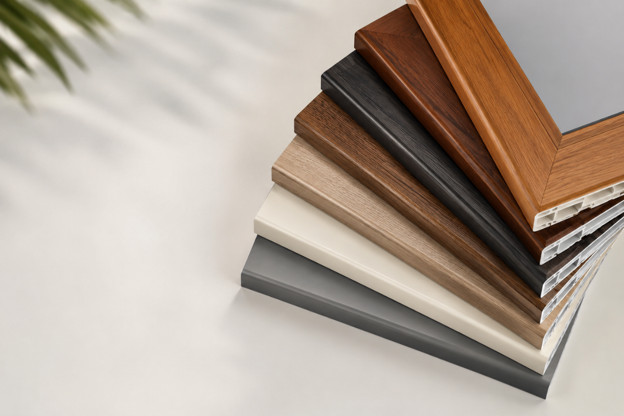
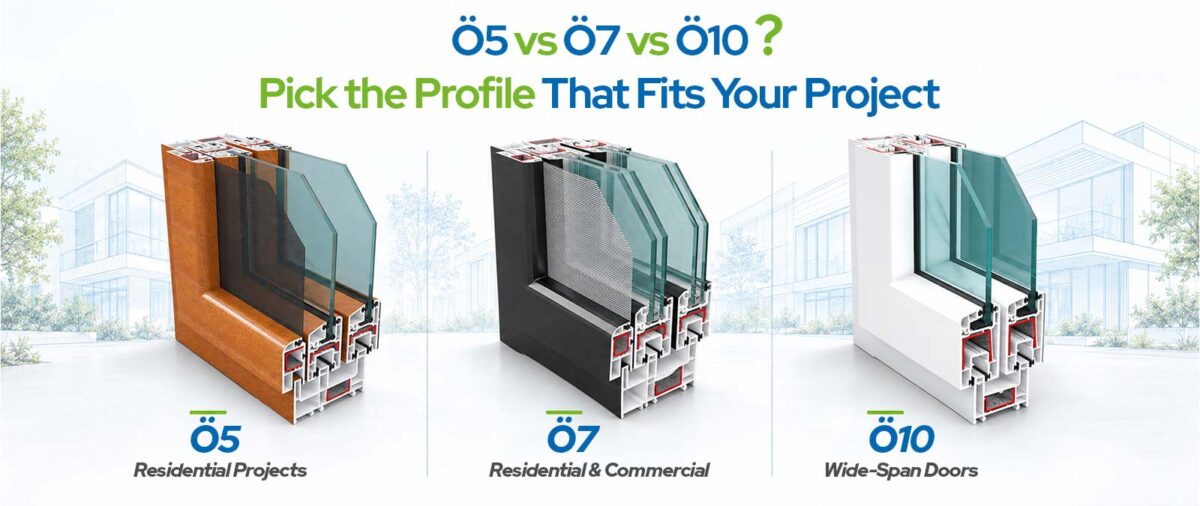
White uPVC gets its colour from the extrusion compound. Laminated uPVC colours — woodgrain, architectural shades, dual-tone — are made by bonding a foil layer onto the extrusion. Performance depends on extrusion quality, laminate construction, embossing, and manufacturing precision, not the shade itself.
Colour is the visible result of several manufacturing steps: extrusion, surface preparation, and lamination. Each step affects dimensional stability, laminate adhesion, and surface performance.
Architects, fabricators, and homeowners should evaluate laminated uPVC colours based on how they are manufactured, not just how they look.
Laminated uPVC colours are an engineered outcome. The finish, the extrusion, and the manufacturing process together determine long-term performance.
How Laminated uPVC Colours Are Made
A laminated colour combines a structural uPVC extrusion with a decorative laminate layer. The laminate becomes a permanent part of the profile — unlike paint, it does not sit as a removable surface coating. Lamination does not change the mechanical function of the profile; it adds a surface layer.
Quality depends on the interaction between the extrusion, the decorative foil, the bonding system, and the process controls used during manufacturing.
A laminated uPVC colour system combines:
- Structural uPVC extrusion
- Decorative laminate
- Bonding system
- Surface finishing
- Manufacturing process control
Why Extrusion Quality Determines How Laminated uPVC Colours Perform
The laminate follows the shape of the extrusion. If the extrusion has dimensional variation — in wall thickness, contours, or geometry — the laminate reproduces that variation. The laminate cannot fix problems created during extrusion.
Wall thickness, external contours, glazing rebates, and reinforcement chambers are all set during extrusion, before the foil is applied. Consistent results depend on controlled extrusion parameters, accurate die calibration, and uniform cooling.
What to check when comparing laminated uPVC colours
- Profile dimensional consistency
- Wall thickness uniformity
- Surface smoothness
- Profile geometry
- Manufacturing tolerances
Note: Two laminated colours can look the same in a showroom. Differences in the underlying extrusion can still affect long-term laminate performance.
Also Read: Modern Kitchen Window Grill Design
What a Decorative Foil Is Made Of
The foil used for laminated uPVC colours has multiple layers. It is not a single decorative film.
| Layer |
Function |
| Protective Surface Layer |
Colour stability and surface durability |
| Décor Layer |
The colour or woodgrain pattern |
| Bonding Layer |
Connects the laminate to the profile |
| uPVC Profile |
Structural support and dimensional stability |
Long-term performance depends on how well the laminate holds adhesion, handles thermal movement, and keeps a consistent surface over time.
Note: Ask for technical documentation on the laminate system, not just a colour swatch.
Laminate Adhesion Depends on Process Control, Not Adhesive Quantity
Adhesion comes from surface preparation, bonding technology, and manufacturing consistency. Adding more adhesive does not improve adhesion.
Before lamination, the profile surface must be prepared for consistent bonding, including on flat sections, glazing rebates, and corners. Consistent manufacturing controls and correct bonding conditions matter more than adhesive volume.
Consistent adhesion affects
- Surface appearance
- Grain alignment
- Edge definition
- Long-term laminate stability
- Fabrication quality
Woodgrain Laminated uPVC Colours
Woodgrain laminates combine a printed grain pattern with embossing. Embossing changes how light reflects off the surface. A flat, printed surface reflects light evenly and does not look like real wood; an embossed surface does not.
What to check on woodgrain laminates
- Grain definition
- Emboss consistency
- Surface texture
- Colour uniformity
- Compatibility with surrounding façade materials
Golden Oak and Walnut
Golden Oak and Walnut are chosen based on what they need to match — façade material, interior finishes, or architectural style.
Golden Oak has warm tones and moderate grain definition. It suits sandstone, exposed brick, textured render, and traditional roofs.
Walnut has more tonal contrast and a more restrained grain pattern. It suits contemporary façades, darker flooring, stone cladding, and larger glazing areas.
Note: Check physical samples in daylight next to the project’s actual façade materials before finalising a colour.
Anthracite Grey and Matte Black
Anthracite Grey and Matte Black are common in contemporary architecture because they create defined frame lines. Dark colours absorb more solar radiation and reach higher surface temperatures than light colours. This is normal for exterior materials and is not, by itself, a problem.
What matters is how the full profile system handles thermal movement: profile geometry, laminate construction, reinforcement compatibility, and fabrication quality.
What to check for dark laminated colours
- Profile dimensional stability
- Laminate construction
- Reinforcement compatibility
- Fabrication recommendations
- Installation guidance
- Local climate conditions
Note: Dark colours should be assessed as part of the full profile system, not judged on colour alone.
Surface Gloss and Embossing
Gloss level determines how much light a surface reflects. Higher gloss reflects more light; matte finishes scatter light more evenly. Embossing adds texture that changes how light hits the surface, which affects how much a woodgrain finish looks like real wood.
| Surface Finish |
Effect |
Typical Use |
| Smooth Gloss |
High reflection, uniform look |
Contemporary residential |
| Matte Finish |
Lower glare |
Modern residential and commercial |
| Embossed Woodgrain |
Textured, more grain definition |
Timber-style architecture |
Note: Check samples in daylight, not just under showroom lighting.
Dual-Tone Laminated uPVC Colours
Dual-tone profiles use one colour on the interior face and a different colour on the exterior face. Profile geometry stays the same; only the laminate on each side differs.
Common Colours combinations
| Interior |
Exterior |
Used For |
| Golden Oak |
Anthracite Grey |
Contemporary villas |
| Walnut |
Charcoal Grey |
Premium residences |
| White |
Anthracite Grey |
Urban apartments |
| White |
Matte Black |
Commercial buildings |
Colour Retention and Weathering
Laminated uPVC colours are exposed to sunlight, rain, dust, and temperature change over time. Colour retention depends on laminate quality, manufacturing, and maintenance — not on which colour was chosen.
Check technical documentation for weathering performance rather than judging by appearance alone. Routine cleaning with manufacturer-recommended methods removes dust and contaminants that affect appearance over time.
Colour retention depends on laminate construction, profile engineering, and environmental exposure — not the colour itself.
Also Read: How to Stop Window Leakage in Monsoon
Choosing a Laminated uPVC Colour by Architectural Style
| Style |
Recommended Finish |
Reason |
| Traditional Homes |
Golden Oak, Walnut |
Matches brick, stone, timber |
| Contemporary Villas |
Anthracite Grey |
Clean lines around glazing |
| Luxury Residences |
Dual-tone |
Warm interior, contemporary exterior |
| Commercial Buildings |
Matte Black |
Minimalist material palette |
Note: Check samples against the project’s actual façade, glazing, and cladding materials before finalising.
Checklist for Evaluating Laminated uPVC Colours
| Parameter |
Why It Matters |
| Profile dimensional consistency |
Substrate stability for lamination |
| Laminate construction |
Surface durability and colour retention |
| Surface embossing |
Grain definition and light reflection |
| Colour consistency |
Uniform appearance across profiles |
| Laminate adhesion |
Long-term surface integrity |
| Profile geometry |
Laminate conformity across sections |
| Technical documentation |
Supports evaluation |
| Maintenance guidance |
Preserves appearance over time |
Frequently Asked Questions
Are all uPVC window colours made using decorative lamination?
No. Standard colours like white come from the extrusion compound. Woodgrain, architectural, and dual-tone colours are made through a separate lamination process.
Do laminated uPVC colours improve structural strength?
No. Lamination affects the surface only. Structural performance depends on profile design, reinforcement, and fabrication quality.
Why are woodgrain laminates embossed?
Embossing changes how light reflects off the surface, which makes it look more like real wood than a flat printed surface does.
Are Anthracite Grey and Matte Black suitable for Indian climatic conditions?
Yes, but check profile engineering, glazing, and manufacturer guidance for the specific location — not colour alone.
Can different colours be used on the interior and exterior of the same profile?
Yes. Dual-tone profiles use separate laminates on each face with the same underlying structure.
Conclusion
Laminated uPVC colours are part of the full profile system, not a standalone decorative choice. Extrusion engineering, laminate construction, and manufacturing precision determine how a colour performs over time — not the colour itself.
Evaluate laminated uPVC colours by checking profile geometry, laminate construction, manufacturing consistency, and available technical documentation, in addition to appearance.
If you are looking for laminated uPVC profiles for your project, get in touch with Okotech. It offers lead-free, UV-resistant, durable, and low-maintenance laminated uPVC profiles. The machinery is imported from Germany, and quality is checked at every stage to produce high-performance discolouration profiles.