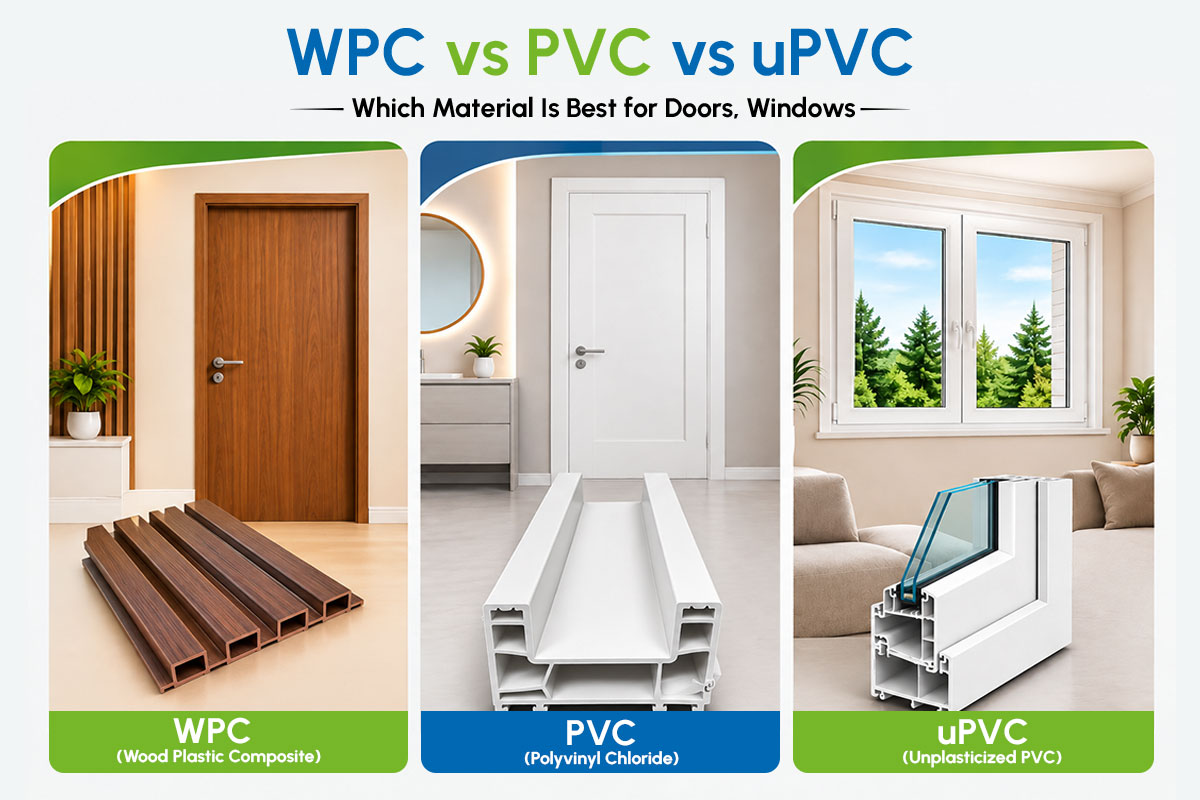
uPVC, WPC, and PVC are used in different types of doors and windows. While these materials may look similar in some applications, their properties, strength, durability, and suitability can vary significantly.
Doors and windows need to withstand regular use, moisture, weather conditions, and temperature changes. Among these materials, uPVC is widely used for windows and doors because of its rigidity, weather resistance, and low maintenance. WPC can be considered for doors where moisture resistance and a wood-like appearance are required, while PVC is generally suitable for lighter applications where cost is a major consideration.
This guide explains the main differences between WPC, PVC, and uPVC and helps you choose the right material for your doors and windows.
Key Takeaways
- WPC (Wood Plastic Composite) is suitable for doors where a wood-like appearance and moisture resistance are required.
- PVC (Polyvinyl Chloride) is an economical material generally used for lightweight applications.
- uPVC (Unplasticised PVC) is a rigid, weather-resistant material widely used for windows and doors.
- WPC, PVC, and uPVC offer good moisture resistance, while their strength and performance differ depending on the application and product quality.
- PVC is generally more affordable than WPC and uPVC.
- For structural windows and exterior doors, uPVC is generally the more suitable option.
What Is WPC?
WPC stands for Wood Plastic Composite. It is made by combining wood fibres or wood flour with thermoplastic materials and additives. The material is designed to provide a wood-like appearance while offering good resistance to moisture, warping, termites, and borers.
Common Uses
WPC can be used for:
- Doors
- Bathroom doors
- Bedroom doors
- Utility-area doors
- Door shutters
- Door frames, depending on the product design and application
Strengths
WPC offers good moisture resistance compared with conventional wood. It is also resistant to termites and borers. The material can be cut, drilled, and screwed using methods similar to those used for wood-based products.
WPC can provide a solid feel and is available in different finishes depending on the manufacturer.
Limitations
WPC is not normally the first choice for structural window frames or large exterior door systems. Window and door frames need to handle factors such as wind loads, glazing weight, hardware loads, and long-term dimensional stability.
The performance of WPC can also vary depending on its composition, density, thickness, and manufacturing quality.
What Is uPVC?
uPVC means Unplasticised Polyvinyl Chloride. Unlike flexible PVC, it does not contain plasticisers, which makes it a rigid material suitable for window and door profiles.
uPVC is widely used for windows and doors because the profiles can be engineered for strength, weather resistance, sealing, and thermal performance.
In larger or heavier systems, galvanised steel reinforcement may be placed inside the profile to provide additional strength.
Common Uses
uPVC is mainly used for:
- Window frames
- Door frames
- Sliding windows
- Sliding doors
- Casement windows
- Casement doors
- Balcony doors
- Exterior doors
Strengths
uPVC has good rigidity and can withstand moisture and outdoor weather conditions. It can also provide thermal insulation and requires relatively low maintenance.
Unlike wood, uPVC does not rot and is resistant to termite damage. It is available in different colours, finishes, and woodgrain designs.
Limitations
uPVC usually costs more than standard PVC. Larger window and door systems may also require steel reinforcement depending on the system design.
The final performance of a uPVC window or door depends not only on the profile but also on reinforcement, glazing, hardware, seals, fabrication, and installation quality.
What Is PVC?
PVC stands for Polyvinyl Chloride. It is a widely used plastic material available in different forms and levels of flexibility.
Compared with uPVC, standard PVC is generally less rigid and is therefore not normally the preferred material for structural window and door frames.
PVC may be considered for lightweight door applications where structural requirements are lower and cost is an important factor.
Core Differences: uPVC vs WPC vs PVC
Material Composition
The three materials have different compositions.
uPVC is a rigid form of PVC that is widely used for window and door profiles.
WPC contains wood fibres or wood powder combined with thermoplastic materials.
PVC is a plastic material available in different forms and is commonly used for lightweight applications.
Appearance
uPVC profiles are available in smooth finishes, solid colours, and woodgrain designs.
WPC can provide a more natural wood-like appearance.
PVC is available in different colours, patterns, and finishes depending on the product.
Weight and Strength
WPC is a dense material and can hold screws directly.
uPVC profiles may contain galvanised steel reinforcement, particularly in larger window and door systems.
Standard PVC is generally less rigid and is more suitable for lightweight applications.
PVC vs uPVC: What Is the Difference?
PVC is generally more flexible, while uPVC is rigid because it does not contain plasticisers.
uPVC is therefore better suited to applications where the frame needs to maintain its shape and provide stability.
This is why uPVC is widely used for windows and doors, while standard PVC is generally used for lighter applications.
PVC vs uPVC: Which Is Better for Windows and Doors?
PVC is suitable for lightweight applications, while uPVC is stronger,
more weather-resistant and widely used for windows and doors in Indian homes.
| Feature |
PVC |
uPVC |
| Rigidity |
Lower |
Higher |
| Window Use |
Limited |
Widely used for uPVC windows |
| Door Use |
Lightweight applications |
Widely used for uPVC doors |
| Moisture Resistance |
Good |
Very High |
| Weather Resistance |
Depends on product |
High |
| Structural Application |
Limited |
Suitable for designed window and door systems |
| Maintenance |
Low |
Low |
| Typical Cost |
Lower |
Mid to High |
| Best Suited For |
Lightweight plastic applications |
Windows and doors for homes and buildings |
WPC vs PVC: Which Is Better?
There is no single answer because the two materials have different properties and applications.
WPC is more suitable when a solid material, wood-like appearance, and good moisture resistance are required for doors.
PVC can be a practical option for lightweight door applications where keeping costs low is a priority.
- WPC: More suitable for doors where strength, moisture resistance, and a wood-like appearance are required.
- PVC: More suitable for lightweight doors and applications where budget is a major consideration.
- Windows: uPVC is generally more suitable than WPC or standard PVC.
- Exterior doors: uPVC is generally more suitable where weather resistance and rigidity are required.
Best Applications
uPVC Windows
uPVC is commonly used for exterior windows because the profiles can provide good weather resistance and sealing.
The combination of uPVC profiles, suitable glazing, seals, and hardware can also help provide thermal and sound insulation.
uPVC Doors
uPVC doors can be used for balconies, utility areas, entrances, patios, and other exterior openings where moisture and weather exposure are concerns.
WPC Doors
WPC can be used for doors where moisture resistance and a wood-like appearance are required.
It can be considered for bedrooms, bathrooms, utility areas, and other door applications depending on the product specification.
PVC Doors
PVC can be considered for lightweight door applications where structural requirements are limited.
It can be a practical option when affordability is a priority.
Comparison of WPC vs PVC vs uPVC for Doors and Windows
| Feature |
WPC
(Wood Plastic Composite) |
PVC
(Polyvinyl Chloride) |
uPVC
(Unplasticised PVC) |
| Primary Role |
Door material |
Lightweight plastic material |
Window and door profile material |
| Best For |
Doors |
Lightweight doors |
Windows and doors |
| Moisture Resistance |
High |
Good |
Very High |
| Termite/Borer Resistance |
Good |
Good |
Good |
| Structural Strength |
Moderate to High |
Low to Moderate |
High |
| UV/Weather Resistance |
Moderate |
Depends on product |
High |
| Typical Cost |
Mid-range |
Low |
Mid to High |
| Finish/Appearance |
Wood-like options |
Various finishes |
Smooth / woodgrain finishes |
| Window Use |
Not typical |
Limited |
Widely used |
| Exterior Door Use |
Limited |
Limited |
Suitable |
Which Material Should You Choose?
Choosing Windows
uPVC is generally the best choice among these three materials for windows.
It is designed for rigid profile systems and can provide good weather resistance, stability, sealing, and long-term performance.
Choosing Exterior Doors
uPVC is generally the more suitable choice for exterior doors where the door is exposed to rain, sunlight, humidity, and changing weather conditions.
Choosing Doors
WPC can be a good choice for doors when moisture resistance and a wood-like appearance are important.
Choosing Based on Budget
PVC is generally the most economical option, followed by WPC and uPVC. However, actual pricing depends on thickness, construction, finish, profile design, hardware, and application.
Choosing for Humid or Coastal Areas
uPVC works well for windows and doors exposed to humidity and outdoor weather.
WPC can also be considered for doors where moisture resistance is required.
Proper installation, sealing, hardware selection, and regular maintenance are important for long-term performance.
Frequently Asked Questions
Which is better, uPVC or WPC?
They are suited to different applications. uPVC is mainly used for windows and doors, while WPC can be used for doors where moisture resistance and a wood-like appearance are required.
Which is better, WPC or PVC?
For doors where strength, moisture resistance, and a solid feel are important, WPC can be a better option. PVC is generally more economical and can be considered for lightweight applications.
Is uPVC better than PVC?
For windows and doors, yes. uPVC is rigid and designed for profile-based applications where the frame needs to maintain its shape and provide stability.
Is Acrylic the same as WPC?
No. WPC is a material, while acrylic is a finishing material. They serve different purposes and should not be considered equivalent materials.
Can WPC be used for windows?
WPC is not normally used for structural window frames. Window frames need profiles designed to handle glazing weight, wind loads, hardware, and outdoor exposure. uPVC is generally more suitable for these applications.
Which material is best for exterior doors?
Among WPC, PVC, and uPVC, uPVC is generally the more suitable choice for exterior doors because it is designed for weather exposure and provides the rigidity required for door profile systems.
Which material is best for bathroom doors?
WPC can be a suitable choice for bathroom doors because of its moisture resistance. uPVC can also be considered depending on the design and exposure conditions.
Is uPVC more expensive than WPC and PVC?
uPVC is generally more expensive than standard PVC. WPC prices vary depending on board composition, thickness, density, and manufacturer.
The final cost of a door or window also depends on hardware, glazing, reinforcement, fabrication, and installation.
Which material has the longest lifespan?
Good-quality uPVC windows and doors can provide a long service life when properly manufactured, installed, and maintained.
Actual lifespan depends on the profile quality, hardware, glazing, weather conditions, installation, and maintenance.
Does WPC hold screws and hardware well?
WPC can hold screws directly because it is a solid board material.
uPVC window and door profiles generally use internal galvanised steel reinforcement for fixing hardware where required. Therefore, the fixing method is different for the two materials.
Conclusion
The right material depends mainly on the application.
uPVC is a suitable choice for windows and exterior doors because of its rigidity, weather resistance, moisture resistance, and suitability for dedicated window and door profile systems.
WPC is a suitable option for doors where moisture resistance, durability, and a wood-like appearance are important.
PVC is useful for lightweight applications where structural requirements are lower and keeping the cost low is a priority.
For homeowners choosing doors and windows, the material is only one part of the overall performance. Profile design, reinforcement, glazing, hardware, seals, fabrication quality, and installation also play an important role.
Okotech manufactures lead-free uPVC profiles for windows and doors. The profiles are made at a modern manufacturing facility using German extrusion technology and precision machinery.Get in touch with us today for your project requirements.