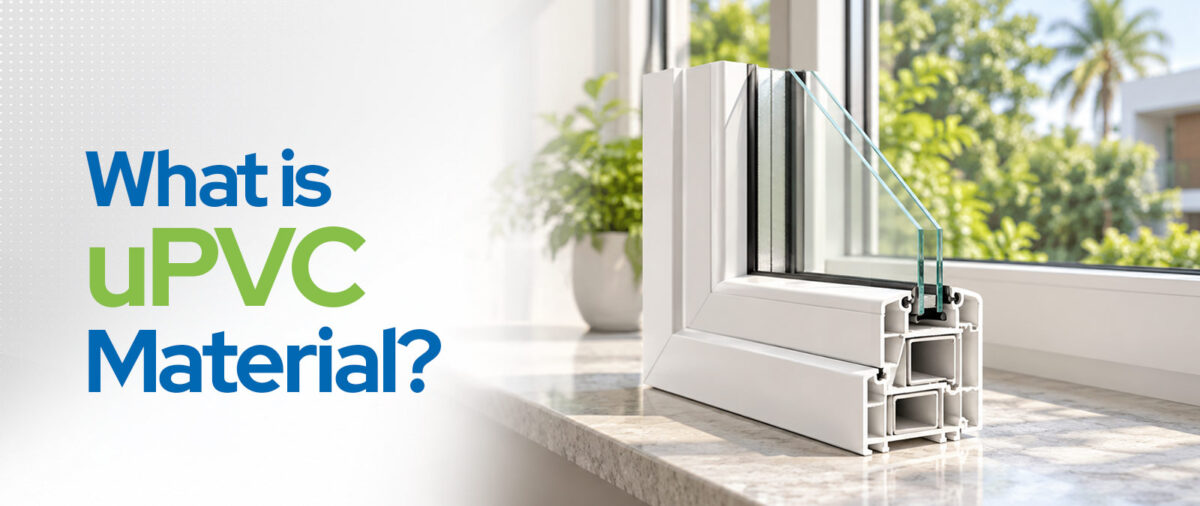
uPVC stands for Unplasticised Polyvinyl Chloride. It is a rigid form of PVC formulated without added plasticisers. Because it remains hard and dimensionally stable, uPVC is widely used for window and door profiles and other rigid construction applications.
For windows and doors, the performance of uPVC depends not only on the polymer but also on the profile formulation, profile design, reinforcement, glazing, seals, hardware, fabrication and installation.
What Is the Full Form of uPVC?
The full form of uPVC is Unplasticised Polyvinyl Chloride.
U = Unplasticised
PVC = Polyvinyl Chloride
uPVC is also written as PVC-U or rigid PVC.
What Is uPVC Made Of?
uPVC is a formulated compound rather than a single ingredient. It normally combines PVC resin with functional additives. The exact formulation varies by manufacturer.
uPVC Material Properties
| Property |
Typical value in source |
Why it matters |
| Density |
1.35–1.46 g/cm³ |
Relatively light material for fabrication and installation |
| Tensile strength |
40–50 MPa |
Contributes to profile strength when combined with suitable design and reinforcement |
| Thermal conductivity |
0.14–0.17 W/m·K |
Low heat transfer through the frame compared with aluminium |
| Water absorption |
<0.1% |
Helps resist swelling, rotting and moisture-related damage |
| Vicat softening temperature |
75°C or higher |
Indicates resistance to softening under heat |
| Linear thermal expansion |
~6–8 × 10⁻⁵/K |
Shows why movement allowances and suitable installation are important |
| Sound insulation |
~30–35 dB with standard double glazing; up to ~40 dB with acoustic laminated glazing |
Complete-window acoustic performance depends strongly on glazing and airtightness |
Note: These proportions are indicative and can vary between formulations.
What Is the Chemical Formula of uPVC?
uPVC is based on polyvinyl chloride, whose repeating unit is commonly represented as (C₂H₃Cl)n. The term ‘unplasticised’ describes the formulation: the base PVC polymer is used without added plasticisers.
How Is uPVC Manufactured?
The compound is dry-blended and processed through an extruder to form the required profile. The profile is then calibrated, cooled, and cut. Window and door profiles can have multiple internal chambers that trap air and contribute to insulation and stiffness.
During fabrication, galvanised steel reinforcement may be inserted into the required profile chambers. Frames can be fusion-welded at the corners to form a continuous joint. The completed window or door is then assembled with glazing, gaskets and hardware.
uPVC Material Properties
| Property |
Typical value in source |
Why it matters |
| Density |
1.35–1.46 g/cm³ |
Relatively light material for fabrication and installation |
| Tensile strength |
40–50 MPa |
Contributes to profile strength when combined with suitable design and reinforcement |
| Thermal conductivity |
0.14–0.17 W/m·K |
Low heat transfer through the frame compared with aluminium |
| Water absorption |
<0.1% |
Helps resist swelling, rotting and moisture-related damage |
| Vicat softening temperature |
75°C or higher |
Indicates resistance to softening under heat |
| Linear thermal expansion |
~6–8 × 10⁻⁵/K |
Shows why movement allowances and suitable installation are important |
| Sound insulation |
~30–35 dB with standard double glazing; up to ~40 dB with acoustic laminated glazing |
Complete-window acoustic performance depends strongly on glazing and airtightness |
Disclaimer: These figures represent typical industry averages for generic uPVC. Actual performance values may vary depending on the specific manufacturer’s formulation, profile design, and installation quality. Always verify precise specifications with the manufacturer’s technical data sheet.
What Are uPVC Windows and Doors Made Of?
A uPVC window or door is a complete system, not just a plastic frame.
uPVC profile frame and sash – the extruded sections that form the frame.
Galvanised steel reinforcement – provides structural support where required.
Glazing – single, double or laminated glass depending on the application.
Gaskets and seals – help control air, water and dust leakage.
Hardware – locks, handles, hinges and rollers.
Mesh – optional insect mesh, commonly made from stainless steel or fibreglass.
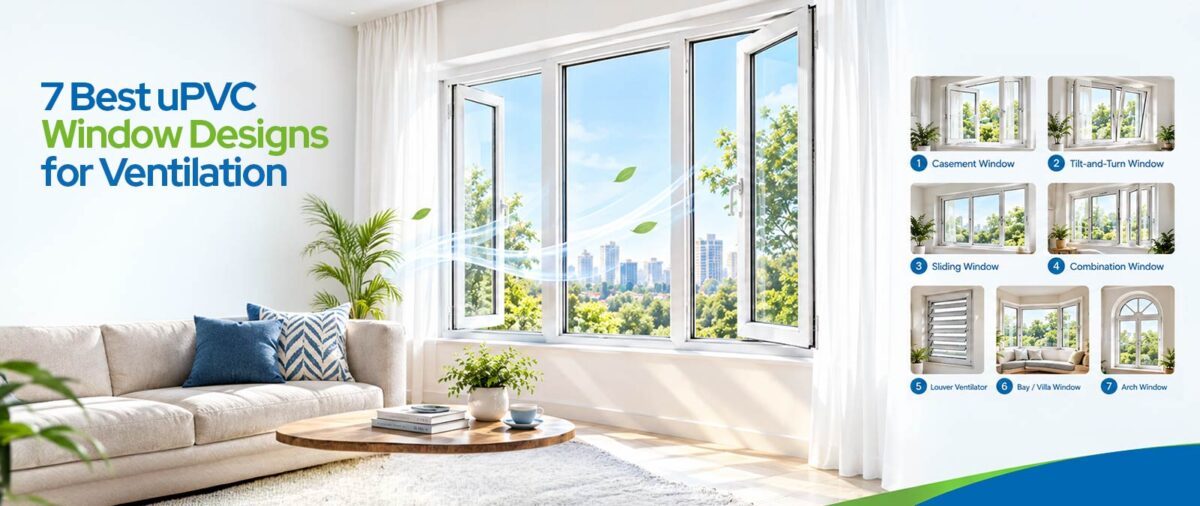
Types of uPVC Windows
uPVC Sliding Windows
Sliding windows move horizontally on tracks and can be useful where simple operation, ventilation and light are required.
uPVC Casement Windows
Casement windows open on side hinges and can provide a large clear opening and good ventilation when correctly designed.
uPVC Tilt and Turn Windows
Tilt-and-turn windows can tilt inward from the top for controlled ventilation or open inward from the side for a larger opening.
Combination windows combine configurations such as fixed, sliding and casement sections in one opening.
Arch windows use a curved top and can be customised for openings where a non-rectangular design is required.
uPVC Villa Windows
Villa windows are designed for larger residential openings and can be specified with suitable glazing, reinforcement and locking systems.
Types of uPVC Doors
Sliding doors move horizontally along tracks and can provide a wide connection between indoor and outdoor spaces.
uPVC Casement Doors
Casement doors open on hinges and are suitable for applications requiring a large opening and a secure closed position.
uPVC Slide and Fold Doors
Slide-and-fold doors use multiple panels that can move and stack to one side, allowing a wider opening when the system is fully opened.
Uses of uPVC
Residential windows and doors
Apartments and villas
Offices and commercial buildings
Hotels, schools and hospitals
Noise-sensitive locations
Humid and coastal environments
Rigid plumbing and pipe applications, where a separate pipe-grade formulation is specified
Window- and door-grade uPVC should not be treated as identical to pressure-rated pipe-grade uPVC. Each is formulated and tested for its intended application.
Advantages of uPVC
Low Maintenance
uPVC generally does not need routine painting, varnishing or polishing. Cleaning with suitable mild detergent and water is normally sufficient.
Weather and Moisture Resistance
Good-quality uPVC profiles are designed to resist moisture and outdoor exposure and do not rust like steel or rot like untreated wood.
Thermal Insulation
uPVC has low thermal conductivity, which helps limit heat transfer through the frame. The final window’s thermal performance also depends on glazing, seals, frame design and installation.
Acoustic Performance
Airtight uPVC frames combined with suitable glazing can reduce outside noise. Glazing selection is a major factor in the final acoustic result.
Termite Resistance
uPVC is not a food source for termites, so it does not suffer termite damage in the same way as wood.
Long-Term Performance
Service life depends on formulation, exposure, fabrication, installation and maintenance. Quality systems can provide long-term service when correctly specified.
Limitations of uPVC
uPVC has relatively high thermal expansion compared with many metals, so installation clearances and reinforcement matter.
Very large openings, tall facades and ultra-slim sightlines can require aluminium or another engineered system.
Manufactured finishes cannot be treated like painted wood; repainting options are limited.
Quality varies across the market, so profile formulation, standards, reinforcement and fabrication should be checked.
Does uPVC Expand in Heat?
Yes. uPVC expands and contracts with temperature changes. Its coefficient of linear thermal expansion is about 6–8 × 10⁻⁵/K in the source material. Suitable reinforcement, profile design and installation clearances help accommodate this movement.
Does uPVC Turn Yellow in Sunlight?
Good-quality uPVC profiles are formulated with UV stabilisers to improve colour stability during outdoor exposure. Titanium dioxide is commonly used in white profiles for UV protection and whiteness. Actual colour retention depends on formulation, exposure and product quality.
Is uPVC Safe for Homes?
Modern window-grade uPVC can be manufactured using stabiliser systems and additives selected for the intended application. Buyers should check the manufacturer’s product specifications and applicable standards rather than assuming every uPVC profile has the same formulation.
Is uPVC Eco-Friendly and Recyclable?
uPVC can be recycled, and its long service life can reduce the frequency of replacement. Environmental performance should be assessed using the complete product system, including manufacturing, service life, recycled content and end-of-life recycling arrangements.
uPVC vs PVC
| Factor |
PVC |
uPVC |
| Plasticisers |
May contain plasticisers |
No added plasticisers |
| Nature |
Can be flexible |
Rigid |
| Typical Uses |
Flexible products and various applications |
Windows, doors and other rigid applications |
| Formulation |
Varies by application |
Formulated for rigidity |
uPVC vs Wood
| Factor |
uPVC |
Wood |
| Maintenance |
Low |
Usually higher |
| Moisture/rot |
Does not rot |
Requires protection from moisture and biological deterioration |
| Termites |
Not susceptible in the same way as wood |
Can be susceptible depending on wood and treatment |
| Appearance |
Manufactured finishes |
Natural material appearance |
| Thermal performance |
Good frame insulation |
Can also provide good insulation depending on construction |
| Choice depends on |
Performance, maintenance and system requirements |
Appearance, material preference and maintenance requirements |
uPVC vs WPC
| Factor |
uPVC |
WPC |
| Material type |
Rigid PVC-based profile material |
Wood-plastic composite |
| Typical applications |
Windows and doors |
Commonly used in doors and interior or wet-area applications |
| Moisture resistance |
High |
Generally high, depending on formulation |
| Maintenance |
Low |
Low to moderate depending on finish and application |
| Selection |
Depends on window and door system requirements |
Depends on application and required appearance or performance |
uPVC vs Wood vs WPC
| Factor |
uPVC |
Aluminium |
Wood |
WPC |
| Typical service life |
25–35 years in source |
30–40+ years in source |
15–30 years, maintenance-dependent |
15–25 years in source |
| Maintenance |
Very low |
Low |
High |
Low–moderate |
| Thermal insulation |
Excellent in source |
Poor unless thermally broken |
Good |
Moderate |
| Acoustic performance with DGU |
Very good |
Good |
Good |
Moderate |
| Termite/moisture |
Immune in source |
Immune in source |
Vulnerable |
Largely resistant |
| Typical fit |
Homes, mid-rise and noise-prone sites |
Large spans, facades and slim sightlines |
Heritage/natural aesthetics |
Interiors and wet areas |
How to Identify High-Quality uPVC
Check applicable standards and request supporting documentation.
Check profile wall thickness and classification.
Confirm whether galvanised steel reinforcement is provided where required.
Look at the multi-chamber profile design, not only the number of chambers.
Check UV-stabilisation and colour-retention specifications.
Check the sealing arrangement and gasket material.
Check the glazing specification.
Check the hardware, locking system, rollers and hinges.
Check fabrication quality, including welded corners where applicable.
Check warranty terms and the installation provider.
uPVC Standards in India
The source identifies IS 17953:2023 as an Indian standard for uPVC window and door profiles and also references EN 12608. Buyers should ask the manufacturer which applicable standard the profile and complete system conform to and request documentation where relevant.
How to Choose uPVC Windows
Start with the opening size and building type.
Consider climate, sunlight, rain, humidity and exposure.
For high-rise buildings, check project-specific wind-load requirements.
Choose glazing based on heat, daylight, safety and noise requirements.
Check reinforcement for the required opening and shutter size.
Check drainage paths and weather sealing.
Select hardware based on shutter weight and frequency of use.
Compare complete specifications rather than only the frame price.
Choosing a uPVC Sliding Door With Mesh for a Balcony
Track configuration: a dedicated mesh track allows the mesh and glass shutters to operate independently.
Mesh material: SS304 stainless steel is more resistant to corrosion and physical damage than many basic mesh options; fibreglass is lighter and easier to replace.
Interlocks: reinforced interlocks help resist movement at the meeting sections of sliding shutters.
Rollers: select rollers rated for the actual shutter weight, particularly with double glazing.
Drainage: concealed drainage should allow rainwater to exit the outer frame.
Glazing: select glazing according to noise, sunlight and safety requirements.
Wind load: high-rise balcony doors should be checked for project-specific wind loads.
Is uPVC Suitable for Indian Homes?
uPVC can be suitable for Indian homes when the complete system is selected and installed for local conditions. Strong sunlight, monsoon rain, humidity, traffic noise, wind exposure, opening size, and building height should all be considered.
For Indian projects, do not evaluate a window only by the material name. Profile formulation, reinforcement, glazing, seals, hardware, fabrication, and installation all influence performance.
How to Maintain uPVC Windows and Doors
Clean frames with mild detergent and water.
Do not use abrasive or solvent-based cleaners.
Clear drainage slots before and during the monsoon.
Lubricate locks, hinges and rollers as recommended.
Inspect gaskets periodically and replace hardened or damaged seals.
Check operation if shutters become difficult to slide or close.
uPVC Material: Quick Facts
| Question |
Short answer |
| uPVC full form |
Unplasticised Polyvinyl Chloride |
| What is uPVC? |
A rigid PVC formulation without added plasticisers |
| Main use |
Window and door profiles, plus other rigid applications |
| What makes uPVC rigid? |
The formulation does not use added plasticisers |
| Main performance factors |
Formulation, profile design, reinforcement, glazing, seals, hardware and installation |
| Main alternatives |
Aluminium, wood and WPC |
Conclusion
uPVC is a rigid PVC-based material used widely in modern window and door systems. Its main characteristics include rigidity, low maintenance, moisture resistance and low thermal conductivity. However, the material alone does not determine the performance of a finished window.
For a reliable comparison, evaluate the complete system: profile formulation and wall thickness, reinforcement, chambers, glazing, seals, hardware, drainage, fabrication, applicable standards, and installation. This approach gives a more useful basis for choosing uPVC for a home or building project.
If you are a fabricator, window and door manufacturer, builder, architect, structural engineer, project consultant, wholesaler, distributor, or contractor, and you need uPVC material for your project needs, get in touch with Okotech for durable and lead-free uPVC profiles.
Frequently Asked Questions About uPVC
What is uPVC?
uPVC is Unplasticised Polyvinyl Chloride, a rigid form of PVC formulated without added plasticisers.
What is the full form of uPVC?
The full form is Unplasticised Polyvinyl Chloride.
What is uPVC material made of?
It is a PVC-based compound containing resin and functional additives such as stabilisers, fillers, impact modifiers, pigments and processing aids.
What is the chemical formula of uPVC?
The PVC repeating unit is commonly represented as (C₂H₃Cl)n. ‘Unplasticised’ refers to the formulation without added plasticisers.
What is uPVC used for?
It is widely used for window and door profiles and other rigid construction applications.
What is the difference between PVC and uPVC?
PVC can be formulated to be flexible, while uPVC is formulated without added plasticisers and remains rigid.
Is uPVC safe?
Window-grade uPVC can be manufactured for residential use using appropriate stabilisers and additives; check product specifications and standards.
Does uPVC turn yellow?
Quality UV-stabilised profiles are designed to maintain colour, but colour retention depends on formulation, exposure and product quality.
Does uPVC expand in heat?
Yes. uPVC expands and contracts with temperature, so suitable design, reinforcement and installation clearances are important.
Is uPVC recyclable?
Yes, uPVC can be recycled; actual recycling depends on collection and processing systems.
How long does uPVC last?
Service life depends on formulation, exposure, fabrication, installation and maintenance; the source gives 25–35 years as a typical range for uPVC systems.
Is uPVC better than aluminium?
They suit different applications. uPVC offers strong thermal insulation, while aluminium can suit large openings, façades and slim sightlines.
Is uPVC better than wood?
uPVC generally needs less maintenance and resists moisture and termites, while wood offers a natural appearance. The choice depends on project requirements.
What are the types of uPVC windows?
Common types include sliding, casement, tilt-and-turn, combination, arch and villa windows.
What are the types of uPVC doors?
Common types include sliding, casement and slide-and-fold doors.
What is window-grade uPVC?
It is a uPVC formulation and profile system designed for window and door requirements such as UV stability, rigidity and outdoor exposure.
Is pipe-grade uPVC the same as window-grade uPVC?
No. Pipe-grade and window-grade uPVC are separate product categories formulated and tested for different requirements.
What standard applies to uPVC window profiles in India?
The source identifies IS 17953:2023 for uPVC window and door profiles and also references EN 12608.
What should I check before buying uPVC windows?
Check standards, wall thickness, reinforcement, profile design, glazing, seals, hardware, drainage, wind-load requirements, warranty and installation.