Choosing a door is not only about matching it with your interiors. You also need to see how it will work in the space. A balcony door should open easily without disturbing the furniture nearby. For a bathroom, privacy matters more. If your living room opens onto a large terrace, you may want a door that lets you open up the space when needed.
There are several uPVC door designs to consider, from simple hinged doors to sliding and folding options. The choice depends on the size of the opening, how you use the room and the look you prefer.
Below are 20 ideas for different parts of a home. The list includes door opening styles as well as glass, panel and layout options. Some can be combined, while a few need a specialist system and may not be available with every supplier.
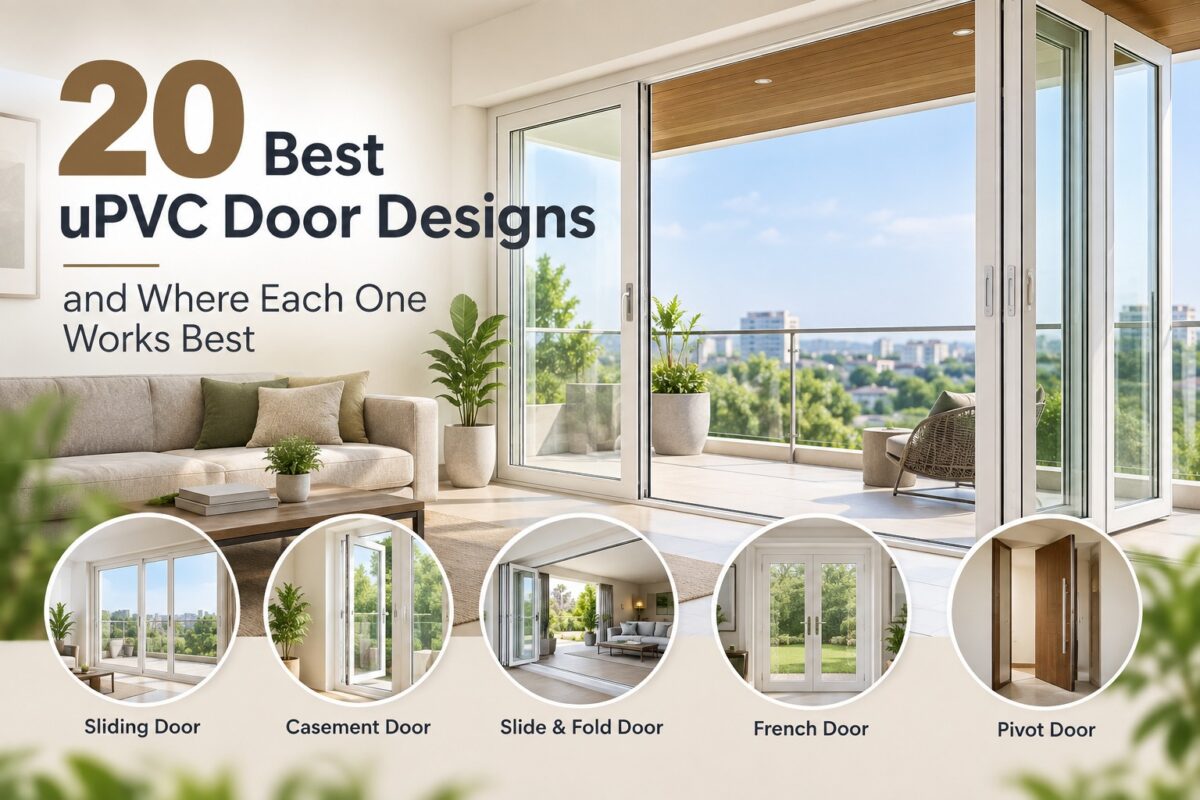
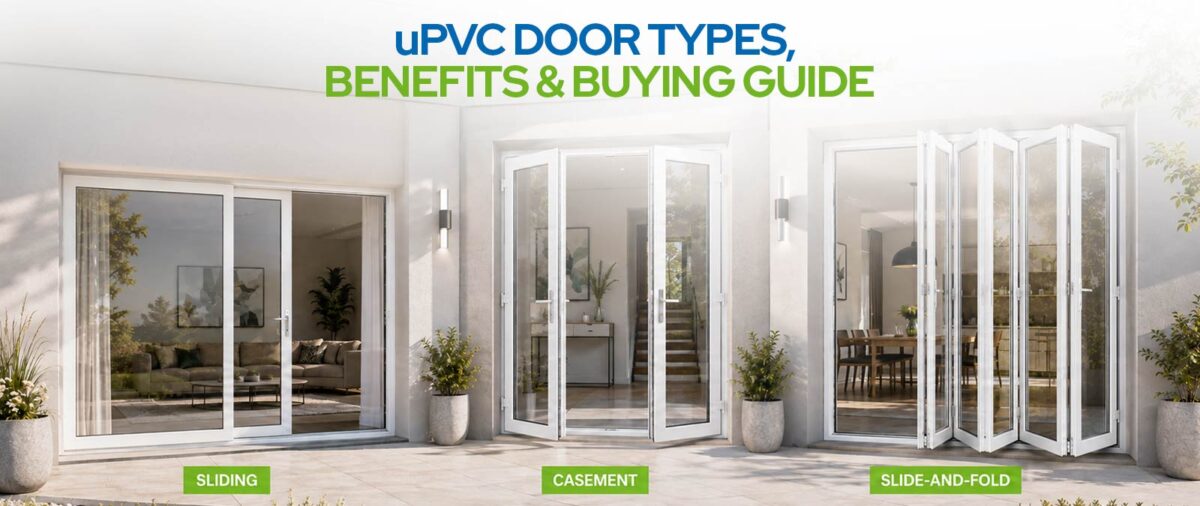
Sliding doors are useful for balconies where there is little room for a door to swing open. Casement doors work well for smaller openings with enough clearance. Slide and fold doors are an option for wide openings leading to a terrace or garden.
For bathrooms and other private spaces, consider suitable frosted glass or an opaque panel. If the door faces rain and wind directly, ask the supplier about the performance of the complete door and how it should be installed.
1. uPVC Sliding Door for a Compact Balcony
In many apartments, the sofa or dining table sits close to the balcony entrance. A sliding door is useful here because its panels move sideways along tracks. You do not have to leave space in front for the door to swing open.
Before deciding, check:
- How much walking space is left when the panels are open.
- The track layout and where the panels overlap.
- Whether the handle is easy to reach and use.
A wider frame or more panels does not always mean a wider passage.
A casement door opens on side hinges, much like a regular hinged door. It is a straightforward option for a kitchen leading to a utility area or a bedroom with a small balcony opening.
The main thing to decide is which way it should open. Make sure the door does not hit a cupboard, washing machine or another door. Both inward and outward opening layouts need enough free space on the relevant side.
3. uPVC Folding Door for Connecting Indoor and Outdoor Spaces
A folding door can be useful when you want to create a wider connection between a living room and an outdoor area. Instead of swinging into the room, the door panels move along their track and gather at the side when opened.
Before choosing this layout, consider:
- Where the panels will sit when the door is open.
- Whether the stacked panels interfere with furniture or movement.
- How much of the opening will remain usable.
- Whether you need to open the entire doorway or only part of it.
4. uPVC French Door for a Garden-Facing Room
French doors usually have two glass door panels that meet in the centre and open on hinges. They suit bedrooms and sitting rooms overlooking a garden, particularly if you prefer a slightly traditional look.
Before choosing one, check the centre of the frame. Some arrangements have a fixed centre post, which affects the passage even when both doors are open. It is also useful to try the lock on the second panel and see how easily it opens.
5. uPVC Tilt and Slide Door for Ventilation
A compatible tilt and slide door gives you two ways to use the opening. It can tilt for limited ventilation or slide open when you need to walk through.
This may be useful for a balcony connection, but the mechanism is not available in every uPVC range. Ask the supplier to demonstrate the exact system. If the balcony is exposed to strong wind or rain, confirm that the proposed door is suitable for that location.
6. uPVC Bi-Fold Door for a Wide Living Room Opening
Bi-fold and folding doors can be described differently by different suppliers. Rather than relying on the name, check how the panels move, where they stack and how much of the opening remains accessible.
For a wide opening used during family gatherings, look at how the panels fold and where they sit when open. Compare the drawings and try the door if a sample is available. The name alone will not tell you how much space it needs or how it operates.
7. uPVC Double-Hinged Door for a Wider Entrance
A double-hinged door has two door panels. You can use one for daily movement and open both when you need a wider passage. The panels can have glass, opaque sections or a mix of both. A fully glazed version may also be described as a French door.
This arrangement can suit wider room openings. For a main entrance, get the supplier to confirm that the complete door is suitable for that use. Discuss:
- Locks and other hardware.
- Reinforcement inside the frame and door panels.
- The glass or opaque panel specification.
- How the frame will be fixed to the opening.
8. Low-Threshold uPVC Door for Easier Access
A high bottom track can be awkward to step over. A low-threshold option reduces this height and can make movement between rooms or onto a balcony easier.
It needs to be part of a compatible door system. If wheelchair access is required, check the clear width, floor levels and effort needed to open the door as well. A low threshold by itself is not enough. For an outdoor opening, plan drainage carefully with the installer.
9. Double-Glazed uPVC Door for Better Indoor Comfort
Double glazing has two glass panes with a sealed gap between them. It can be used in suitable hinged, sliding or folding doors where reducing heat transfer is a priority.
Ask for performance details for the selected glass and the complete door. If outside noise is your main concern, discuss that separately. The glass combination, seals and installation all affect noise reduction; double glazing alone does not make a door soundproof.
10. uPVC Door with a Separate Grille for Ground-Floor Openings
For a ground-floor room, you may want a grille outside the glass door. There should be enough gap between the two so you can open the door freely and reach the glass for cleaning.
A few things need attention during installation:
- The grille should not obstruct the door or handle.
- Its fixing needs to be suitable for the wall or supporting structure.
- Any opening needed for emergency escape must remain usable.
The grille’s appearance alone does not tell you how secure it is. Its construction and fixing matter too.
11. Flush-Look uPVC Panel Door for Simple Interiors
A plain panel door is a good option if you do not want glass or decorative patterns across the doorway. It can work in a study or an interior room with simple furniture.
The term “flush” can mean different things. Some suppliers use it for a flat panel surface, while others mean that the door sits level with the frame. A sample or section drawing will help you understand what you are getting.
Also, confirm the material. A regular PVC interior door is different from a door made with reinforced uPVC profiles.
12. Arched uPVC Door Design for a Traditional Entrance
If your entrance has an arch, you can keep that shape without making the door itself curved. One option is a rectangular door with a fixed arched glass section above it.
For this design, there are two possibilities:
- A regular rectangular door below a fixed arch.
- A door with a curved top, where a suitable system is available.
The second option needs specialist fabrication. Share the design before finalising the opening, as a company that makes arched windows may not make arched doors.
13. Louvered uPVC Door for a Utility or Storage Room
Utility rooms may need airflow even when the door is shut. A louvered panel allows this through small gaps between its angled slats.
Before choosing the panel, consider:
- Whether the slats give enough privacy.
- Whether you need mesh to keep insects out.
- Whether rain can reach the opening.
These gaps also let sound pass through, so do not expect the same sealing as a solid panel.
14. Frosted-Glass uPVC Door for a Bathroom
Clear glass is usually not what you want for a bathroom door. Frosted or patterned glass can let light in while making it harder to see inside.
Still, not every finish gives the same privacy. Some glass shows a person’s outline when they stand close to it. See a sample with light behind it before making your choice.
If you want to block the view completely, an opaque panel is the more suitable option.
15. Multi-Track uPVC Sliding Door for a Wide Balcony
For a wide balcony opening, a multi-track door gives you more panel arrangement options. The panels slide along separate tracks and overlap when opened.
What matters is how much of the doorway you can actually use. Ask for a layout showing:
- The fixed and sliding panels.
- Where the sliding panels stop.
- The clear opening when the door is open.
- The depth of the frame.
Do not assume that every panel moves just because the door has several tracks. They may not move together either.
16. Pivot-Style Entrance Door
A pivot door turns on fittings at the top and bottom rather than hinges along the side. If you have seen this design in a reference image, confirm the material and system before choosing it for your entrance.
It is not a standard option in every uPVC range. The supplier needs to confirm that the proposed system can carry the door’s size and weight.
The Okotech pages linked in this article do not confirm a pivot-door option, so its availability needs to be checked separately.
17. uPVC Door with Insect Mesh for a Balcony
If you often leave the balcony door open for fresh air, a mesh panel is worth considering. You can keep the glass door open and close the mesh to help keep insects out. This arrangement can also be useful between the kitchen and utility area.
Look at these details before choosing one:
- Does the mesh close properly around the edges?
- Is it easy to open and move aside?
- Can you reach it for cleaning?
Air passes through only when the main door is open. Regular insect mesh should not be used as a security barrier or protection against falls.
18. Secondary uPVC Door for a Two-Door Entrance
Some entrances have enough room for a second door, leaving a small space between the two. Whether this works in your home depends on the available floor area and the direction in which each door opens.
Plan the layout so that:
- The handles do not hit each other.
- Neither door blocks the passage.
- Water can drain away from an exposed entrance.
A second door alone does not make the entrance storm-resistant. The doors and their installation still need to suit the location.
19. uPVC Panel Door with a Glass Insert
You may want some light through a door without having glass from top to bottom. A panel door with a smaller glass insert gives you that option.
For a utility room or home office, decide where you need the glass and how much visibility you want.
| Your preference |
What to consider |
| A view through part of the door |
Clear glass insert |
| Light with less visibility |
Frosted or patterned glass insert |
| Glass only near the top |
A higher glass insert |
| No view through the lower section |
An opaque lower panel |
A clear glass insert will still allow a view through it, even if the rest of the door is solid.
20. Corner uPVC Door Arrangement for Views on Two Sides
If a room faces a balcony or garden on two adjoining sides, doors and glass panels can be arranged around the corner. Depending on the layout, some sections may open while others stay fixed.
The main detail to settle early is the corner support. A regular arrangement may have a fixed post where the two sides meet.
If you want both sides to open without a post in the corner, discuss this while planning the building work. It needs a specially engineered solution and cannot be assumed to work with a standard corner frame.
A Quick Comparison of uPVC Door Options
| What you need |
Option to consider |
What to check |
| Save space near the door |
Sliding door |
Clear passage and track layout |
| A simple door for daily use |
Casement door |
Opening direction and free space |
| Connect a room with a terrace |
Folding door system |
Panel stacking space and clear passage |
| A paired glass door overlooking a garden |
French door |
Centre post and second-panel opening |
| Easier movement across the doorway |
Compatible low-threshold door |
Floor levels, clear width and drainage |
| Reduce heat transfer |
Suitable double-glazed door |
Glass and whole-door performance |
| More privacy |
Frosted glass or opaque panel |
Visibility in different lighting |
| Ventilation with the main door open |
Compatible insect mesh |
Edge coverage and ease of use |
| A sliding layout for a broad opening |
Multi-track door |
Frame depth and panel movement |
| An unusual entrance or corner design |
Specialist system |
Availability and structural requirements |
For security, look beyond the door’s appearance. Ask the supplier about the frame, reinforcement, locks, glass or panels, and fixing method. These parts need to work together.
What to Check Before Finalising a uPVC Door
Measure the space around the opening
Start with the doorway measurements, then check the space around it. Include:
- Furniture such as sofas, dining tables and cupboards.
- Curtains and nearby appliances.
- Space needed for a hinged door to open.
- Space occupied by folding panels when stacked.
Decide how much privacy you need
The right glass or panel depends on the room and what is visible from outside.
| Glass or Panel Option |
Where You Might Consider It |
What to Remember |
| Clear Glass |
A room overlooking a garden |
People may be able to see inside. |
| Frosted or Patterned Glass |
A bathroom or another private space |
Some finishes may still show silhouettes. |
| Opaque Panel |
Areas needing complete visual screening through the panel |
The panel blocks the view and does not let light through. |
| Opaque Panel with a Glass Insert |
A utility room or home office |
Privacy depends on the glass type and its position. |
Check visibility from both sides, during the day and at night, before making your choice.
Consider rain, wind and outside noise
An internal door and an exposed balcony door have different requirements. Tell the supplier where the door will be installed and discuss:
- Exposure to rain and wind.
- Drainage around the opening.
- Suitable glass and hardware.
- Relevant acoustic test results if outside noise is a concern.
A general “soundproof” description is not enough to judge how the proposed door will perform.
Confirm the size with the fabricator
Not every system supports the same door height, width or weight. The profile, reinforcement, glass or panel, and hardware all matter. Get the proposed dimensions confirmed before finalising a tall or unusually wide design.
Ask about cleaning and maintenance
A low-maintenance door still needs basic care:
- Keep tracks free from dust and dirt.
- Keep drainage openings clear.
- Use cleaning products recommended by the supplier.
- Follow the care instructions for locks and other moving parts.
Explore uPVC Door Options with Okotech
Once you know the opening size and how you want to use the space, explore Okotech’s sliding, casement, and slide and fold options.
To help the team suggest a suitable option, contact Okotech for more details. Confirm the available layout, glass, hardware, and installation details before placing the order.
Frequently Asked Questions
Is a slide-and-fold design best for a balcony?
A sliding door is a useful choice when there is little space for a door to swing open. A hinged door can suit a smaller opening if there is enough clearance. For a wide terrace opening, you can consider a compatible slide and fold system.
What is the difference between sliding and slide and fold doors?
A sliding door keeps its panels moving horizontally, with panels generally overlapping when open. A folding system brings the panels together at one side, creating a different type of opening. The actual clear passage depends on the configuration selected.
Are bi-fold and slide and fold doors different?
Terminology can vary between suppliers, so check the actual panel arrangement and operating mechanism before choosing a system.
Can uPVC doors be used for a main entrance?
They can be considered if the supplier confirms that the complete door is suitable for entrance use. Check security, weather exposure and daily operation. The appearance of a solid panel alone does not tell you how the door will perform.
Which uPVC door is suitable for a bathroom?
A compatible hinged door with an opaque panel or suitable privacy glass can work. Check the opening space and level of privacy. If you choose a louvred panel for ventilation, remember that it will allow more air and sound to pass through than a closed panel.
Do double-glazed uPVC doors stop outside noise?
They can reduce noise, but they do not block it completely. The result depends on the glass combination, seals and installation. Ask for acoustic test information relevant to the door you plan to buy.
Does a multi-track sliding door open fully?
Not always. It depends on which panels are fixed, which ones move and where they stack. Ask the supplier to show the clear passage with all movable panels fully open.