Choosing a uPVC window colour is not just about how it looks. The right choice also depends on the climate, sunlight, shading, profile design, and the window’s finish.
White and light-coloured uPVC frames are often a practical choice for homes that get strong sunlight because they absorb less solar heat. Darker colours such as Anthracite Grey, Black, Walnut, and Dark Oak can also work well when the profile, finish, and installation are suitable for the local conditions.
This guide covers three common settings in India — coastal areas, the northern plains, and southern cities and plateau regions — and explains how to choose a suitable uPVC window colour.
Why the Best uPVC Window Colour Depends on Your Home
There is no single uPVC window colour that works best for every home in India. A dark frame on a shaded balcony may behave differently from the same frame on a west-facing wall that gets strong afternoon sun.
Colour affects how much heat a window frame absorbs. Darker colours generally absorb more solar heat than lighter colours, which can make the frame hotter and cause more thermal movement. This is why the profile design, reinforcement, seals, finish, and installation also matter.
Before choosing a colour, consider three simple questions:
- What is the local climate?
- How much direct sunlight will the window get?
- Which colour suits the home and its design?
How uPVC Window Colour Technology Works
Modern uPVC windows are available in many more colours and finishes than the traditional white frame. Understanding how these finishes are made can help you choose the right option for your home.
Foil Lamination Instead of Paint
Many coloured uPVC profiles use foil lamination rather than conventional paint. A decorative foil, such as a wood-grain or solid colour finish, is bonded to the uPVC profile using controlled heat and pressure during manufacturing.
The finish is made for outdoor use and does not need regular repainting like a painted surface.
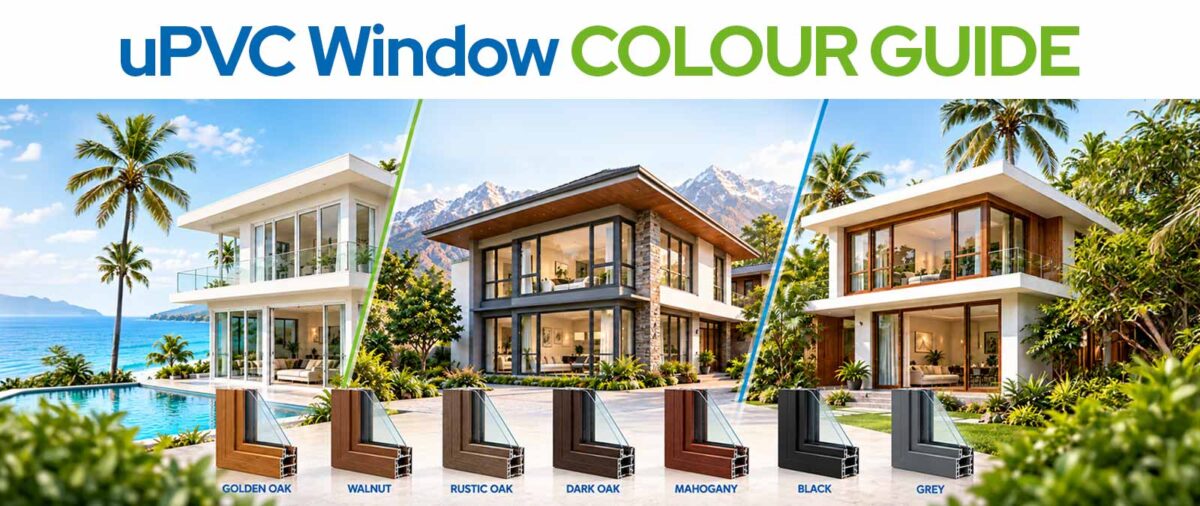
Ökotech offers finishes such as Golden Oak, Walnut, Rustic Oak, Dark Oak, Mahogany, Grey, and Black, along with white. The right finish depends on your preferred look as well as the conditions where the window will be installed.
Colour Quality and Certification
When comparing uPVC profiles, look at both the colour finish and the quality of the base material.
Ökotech’s uPVC compound is 100% lead-free and RoHS-certified. When comparing suppliers, it is a good idea to ask for the relevant certifications in writing rather than relying only on verbal claims.
UV-Reflective Pigment Technology
Some modern coloured uPVC profiles use UV-reflective or “cool colour” pigments. These pigments are designed to reflect more solar infrared radiation than some conventional dark pigments.
This can help certain dark finishes, such as Anthracite Grey, Black and dark wood-grain colours, stay cooler than similar profiles made with conventional pigments.
However, this does not mean that every dark colour is suitable for every location. Sun exposure, building orientation, shading, profile design, reinforcement and finish quality still need to be considered.
If you are choosing a dark finish, ask the manufacturer or fabricator about the pigment technology used and the warranty available for that specific finish.
Dual-Tone uPVC Windows
Dual-tone uPVC windows have different colours on the outside and inside of the frame.
Ökotech’s coloured profile range supports dual-tone options. This allows you to choose a darker or more modern colour for the exterior while keeping the interior lighter.
This is useful if you want the window to match the building’s exterior without using the same dark colour inside the home.
Region 1: Coastal Homes — Mumbai, Chennai, Kerala and Goa
Practical colour choices: White and other light colours.
Darker colours: Black, dark grey and dark wood-grain finishes need more care on exposed, unshaded walls.
Coastal homes often face high humidity, salty air, and strong sunlight. These conditions make the choice of profile, finish, and maintenance important.
Dark uPVC frames generally absorb more heat than lighter colours. On a wall that receives strong, direct sunlight, this can make the frame hotter and increase thermal movement. The profile design, reinforcement, seals, and finish should therefore be suitable for the conditions.
Salt and dust can also be more visible on some dark finishes. Regular cleaning can help keep the frames looking good.
White and light-coloured uPVC frames absorb less solar heat than darker colours, making them a practical choice for highly exposed coastal homes. They still need regular cleaning to remove salt and dirt.
Practical Tip for Coastal Homes
If you want a modern look without using a dark colour on a highly exposed exterior, consider a dual-tone window.
For example, you can choose a lighter exterior to reduce solar heat absorption and use a darker shade such as Grey or Dark Oak on the inside.
Region 2: North Indian Homes — Delhi, Punjab and the Plains
Practical colour choices: White and lighter wood-grain finishes such as Golden Oak.
Darker colours: Black, Grey, Dark Oak, and Mahogany need more care on highly exposed walls.
Homes in northern India can experience very hot summers and cold winters. During summer, dark frames exposed to direct sunlight can absorb more heat, leading to higher frame temperatures and greater thermal movement.
For darker frames in exposed locations, profile design, reinforcement, and finish quality become especially important. Light colours are a practical choice when reducing solar heat absorption is a priority.
This does not mean dark colours cannot be used. Black, Dark Oak, or Mahogany can work well on shaded facades, covered porches, or areas that receive less direct sunlight.
For highly exposed south- and west-facing walls, lighter colours may be a better choice if reducing heat absorption is important.
Practical Tip for North Indian Homes
finishes. It can be a good option for homeowners who want something different from plain white while keeping solar heat absorption lower than with darker wood finishes.
Region 3: South Indian Homes — Bengaluru, Hyderabad and Tamil Nadu
Practical colour choices: Grey, Black, Walnut, Dark Oak, Rustic Oak and dual-tone combinations can all be considered, depending on the location and sunlight exposure.
Grey, Black and wood-look finishes such as Walnut and Rustic Oak are popular choices for modern homes in southern India.
However, the best colour depends on more than the region. Climate, window orientation, shading, and direct sunlight should all be considered before choosing a finish.
Dark frames can still become hot when exposed to strong sunlight for long periods. If you choose a dark or black laminated finish, check the UV resistance of the foil and the manufacturer’s warranty.
Finish quality also matters. Poor-quality finishes may be more likely to show colour or surface changes over time.
Practical Tip for South Indian Homes
A dark exterior with a lighter interior can give you more design flexibility. This works well when you want the outside of the home to have a modern appearance while keeping the interior brighter and lighter.
Conditions can also vary within cities such as Bengaluru and Hyderabad. A shaded window and an unshaded window on a sun-facing wall may experience very different conditions. Look at the actual exposure of the window rather than choosing a colour based only on the city’s climate.
uPVC Window Colour Chart
| Colour / Finish |
Type |
Suitable Applications |
Cost vs. White |
Dual-Tone |
| White |
Solid |
Coastal homes, North Indian plains and a wide range of applications |
Base price |
Yes |
| Golden Oak |
Wood-grain laminate |
Lighter wood-look applications, including North Indian homes |
Additional cost |
Yes |
| Rustic Oak |
Wood-grain laminate |
Wood-look and traditional-style facades |
Additional cost |
Yes |
| Grey |
Solid / laminate |
Contemporary homes and mixed-material facades |
Additional cost |
Yes |
| Walnut |
Wood-grain laminate |
Contemporary and premium wood-look facades |
Additional cost |
Yes |
| Dark Oak |
Wood-grain laminate |
Contemporary homes and shaded applications |
Additional cost |
Yes |
| Mahogany |
Wood-grain laminate |
Premium wood-look applications; consider site exposure |
Additional cost |
Yes |
| Black |
Solid / laminate |
Contemporary facades; consider shading and solar exposure |
Additional cost |
Yes |
Colour pricing varies according to the selected profile, finish, quantity and supplier. White is generally used as the reference point, while coloured and wood-grain finishes may carry an additional cost. Confirm the current price for the selected Ö5, Ö7 or Ö10 profile series with the manufacturer or fabricator.
Matching uPVC Window Colour to Your Home Style
Climate and sunlight help you choose colours that work well for your location. Your home’s design can then help you choose the final shade.
Traditional and Classical Homes
Traditional homes with arched windows, decorative details and courtyard-style designs can work well with Golden Oak or Rustic Oak. These wood-look finishes add warmth while keeping the low-maintenance benefits of uPVC.
Ökotech’s Arch Window range can also suit homes with arched openings and classical design elements.
Modern and Contemporary Homes
Modern homes with clean lines, exposed concrete, and simple designs can work well with Grey, Black and Walnut.
If you choose a very dark colour, also consider how much direct sunlight the windows receive and whether the facade is shaded.
Villa and Luxury-Style Homes
Villas with stone cladding, metal details, and large glass areas can use dual-tone frames to create contrast between the outside and inside.
A darker exterior can complement premium facade materials, while a neutral interior can match a wider range of interior designs.
Ökotech’s Villa Window range is designed for larger residential windows where appearance and style are important.
Cost of Coloured uPVC Windows
Coloured uPVC windows usually cost more than standard white profiles because of the additional colouring or lamination process. The final price depends on the colour, finish, profile, quantity, and supplier.
Coastal Homes
For coastal homes, choosing a darker colour may increase the cost because of the selected coloured or laminated finish. More importantly, check whether the finish and profile are suitable for the amount of sunlight the windows will receive.
North Indian Homes
If you want a wood-look finish, Golden Oak can be considered a lighter alternative to darker wood finishes, especially on walls that receive strong sunlight.
South Indian Homes
Homeowners have a wide range of colours to choose from. Grey, Black and Walnut can work well with contemporary designs when the colour suits both the architecture and the window’s exposure.
What Makes a uPVC Colour Durable?
The durability of a coloured uPVC window depends on more than the outer finish. The profile and its construction also matter.
Ökotech’s Ö-series profiles use a high wall thickness, multi-chambered design, and internal steel reinforcement. These features help provide stability and manage the movement that can occur when the profile heats up and cools down.
When comparing coloured uPVC windows, don’t look only at the colour sample. Also ask about:
- Wall thickness
- Chamber design
- Steel reinforcement
- Finish specifications
- UV resistance
Maintaining uPVC Windows by Colour
White and Light-Coloured Frames
White and light-coloured frames are generally easy to maintain. Clean them regularly with mild soap and water to remove dust and dirt.
In coastal areas, regular cleaning is especially useful for removing salt deposits.
Grey, Black and Dark-Coloured Frames
Dark frames can hide some dust but may show water marks and fingerprints more clearly.
Use a soft, non-abrasive cloth and mild detergent to keep the surface clean.
Wood-Grain Finishes
Wood-grain finishes such as Walnut, Dark Oak, and Rustic Oak can help hide small marks because of their patterned appearance.
For windows that receive strong sunlight, check that the selected laminate is suitable for outdoor use and has appropriate UV resistance.
For all colours, avoid harsh solvents and abrasive cleaning pads, as they can damage the finish.
uPVC Window Colour Buying Checklist
Before choosing your uPVC window colour, ask the manufacturer or fabricator:
- What UV-resistance specification does the finish have?
- What fading warranty applies to the selected colour?
- Is the colour a laminated foil or part of the uPVC extrusion?
- If it is laminated, which foil and lamination process are used?
- Does the base compound have written certifications, such as lead-free and RoHS certification, where applicable?
- What is the additional cost for the selected colour or dual-tone option?
- Can I see a physical colour sample in natural daylight?
- What are the profile’s wall thickness, chamber design, and reinforcement specifications?
- Does the installer have experience with coloured and laminated uPVC windows?
These checks help you choose a window based on the complete product specification, not just its colour.
Frequently Asked Questions
Does a dark uPVC window frame get hotter than a white one?
Generally, yes. Dark colours absorb more solar heat than white and other light colours. Modern UV-reflective pigments can help reduce heat absorption, but they do not remove the difference completely.
For windows on highly exposed south- or west-facing walls, consider sunlight, shading, profile design, reinforcement, and finish quality before choosing a very dark colour.
Which uPVC window colour is best for coastal homes in India?
White and light colours are practical choices because they absorb less solar heat. Regular cleaning is also important in coastal areas to remove salt and dirt.
If you want different colours inside and outside, a dual-tone configuration is another option.
Can I use Grey or Black uPVC windows in Delhi or North India?
Yes. Grey and Black can be used, but very dark colours need more care on walls that receive strong direct sunlight.
Before choosing a dark finish, consider the wall orientation, shading, profile specification, and finish quality.
Why are Grey, Black and Walnut uPVC windows popular in South Indian homes?
These colours work well with modern homes and can create a strong contrast with concrete, stone, and glass.
However, the choice should still take into account the amount of direct sunlight, shading and the position of the window.
Can I have different uPVC window colours inside and outside?
Yes. Ökotech’s coloured profile range supports dual-tone configurations, allowing you to choose one colour for the exterior and another for the interior.
This can help the windows match both the building facade and the interior design.
Do uPVC window colours fade in Indian sunlight?
The performance depends on the profile, foil, pigments, finish, installation and level of sun exposure. Good-quality laminated foils with suitable UV resistance are designed for outdoor use. Before choosing a colour for a highly exposed window, ask the manufacturer about the UV specification and applicable warranty. In general, a reputable manufacturer offers a warranty of 20 years on discolouration.
How much more does a coloured uPVC window cost than a white one?
White is generally the standard-price option. Coloured and wood-grain finishes may cost more depending on the finish, profile, quantity, and supplier.
Check the current price with the manufacturer or fabricator before making a decision.
Is Ökotech’s uPVC compound safe and certified?
Ökotech states that its uPVC compound is 100% lead-free and RoHS-certified. This is because of the usage of eco-friendly calcium-zinc (Ca-Zn) stabilizers instead of traditional lead-based compounds
Conclusion
There is no one uPVC window colour that is best for every home in India. The right choice depends on the climate, sunlight, shading, home design, profile, and finish.
White and light colours are a practical choice for homes that receive strong sunlight. Grey, Black and wood-look colours such as Walnut can also be good options when the window is suitable for the location and exposure.
Before choosing a colour, check the finish, UV resistance, profile quality, certifications, installation, and cost. You can also choose a dual-tone window if you want a darker colour outside and a lighter colour inside.
This guide was compiled and reviewed by the Ökotech Design & Technical Team.
Ökotech manufactures lead-free, RoHS-certified uPVC window and door profiles across the Ö5, Ö7 and Ö10 series. For help choosing the right colour for your home, speak with an Ökotech window expert now.